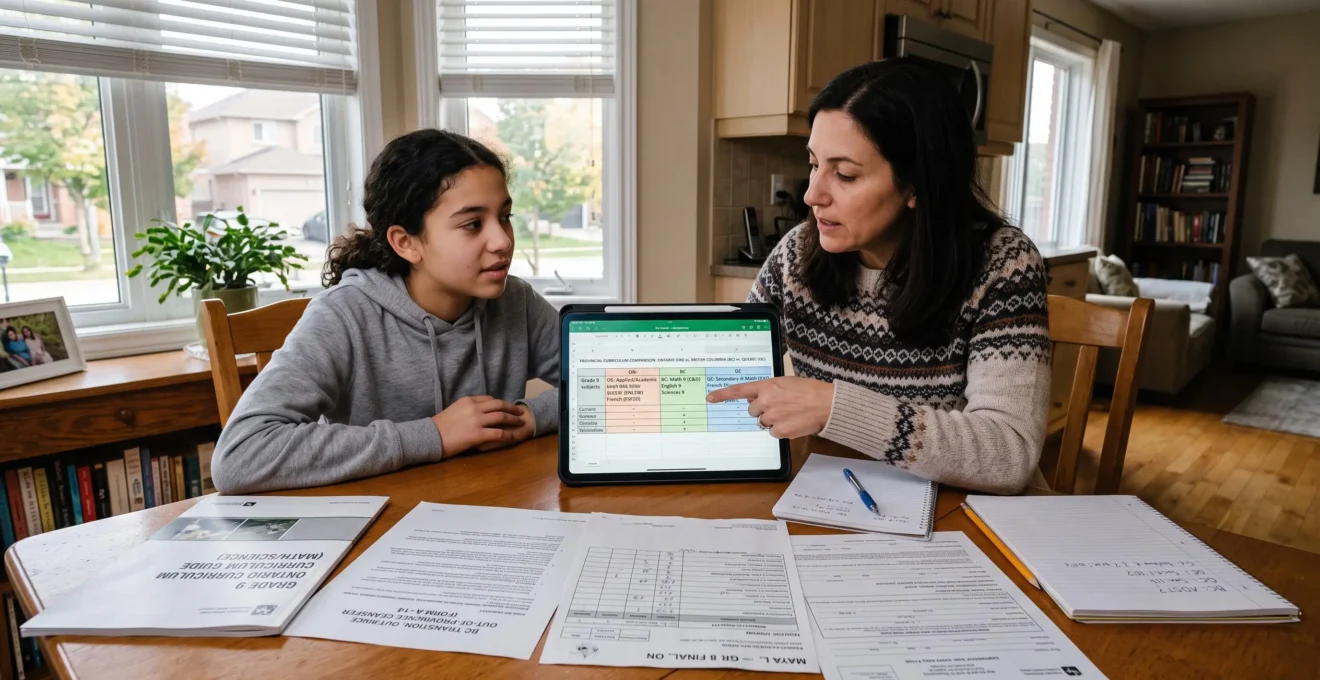
Moving from Ontario to British Columbia, Alberta to Quebec, or between any other Canadian provinces changes more than your child’s school address. The curriculum, language options, assessment methods, registration procedures and available learning supports may all change, even when your child enters the same grade.
Canada does not operate a single national school system. Each province establishes its own educational requirements, meaning that a Grade 7 student who is meeting expectations in one province may encounter unfamiliar material in another. For older students, differences in course credits and graduation requirements can make the transition more consequential.
The important question is not whether one province provides a better education. It is whether the receiving school can recognize your child’s previous learning, identify meaningful gaps and maintain the support needed for a successful transition.
Parents can reduce uncertainty by gathering school records early, comparing curriculum expectations, confirming language-program availability and speaking directly with the receiving school before choosing a moving date.
What parents need to know before changing provinces
- Curriculum differs by province: the same grade does not always cover identical subjects, units or assessments at the same time.
- Placement requires preparation: report cards, transcripts, course information and existing support plans help the receiving school understand your child’s needs.
- Language programs and services need verification: French immersion spaces, English-language eligibility in Quebec and specialized supports should never be assumed to transfer automatically.
- Why Can a Grade 7 Student Be “Ahead” in One Canadian Province and “Behind” in Another?
- How to Evaluate a Canadian School in 1 Visit Without Relying on Online Ratings?
- Which Fits Better in Canada: French Immersion or English Track if You Move Often?
- The School Registration Document Canadians Forget That Delays Placement by 3 Weeks
- When Is the Least Disruptive Time to Switch Schools in Canada if a Move Is Unavoidable?
- Why Does the Same Problem Get a Different Answer in Ontario vs Quebec?
- Why Do Educational Platforms in Canada Stop Working After 3 Weeks for Most Kids?
- Which Educational Platform Works Best in Canada When Your Child Has Only 20 Minutes a Day?
Why Can a Grade 7 Student Be “Ahead” in One Canadian Province and “Behind” in Another?
A Grade 7 student can appear ahead in one Canadian province and behind in another because provincial curricula introduce and assess learning expectations differently. The difference does not necessarily indicate stronger or weaker academic ability. A child may simply have studied a particular concept earlier, later or in a different sequence than classmates in the receiving school.
According to the Council of Ministers of Education overview of elementary and secondary education, Canada has no integrated national education system. Provincial and territorial authorities establish their own curricula, educational programs and assessment practices.
Consequently, parents cannot assume that Grade 7 mathematics in Ontario, Alberta and British Columbia follows an identical sequence. The same principle applies to science, language arts and other subjects.
Consider a hypothetical student who has completed a unit on proportional reasoning before moving provinces. If the receiving class studied that concept earlier in the year, the student may appear well prepared. However, the class may also have covered a different unit that the student has not encountered. The child can therefore be ahead in one area and behind in another without having experienced an overall decline in achievement.
Parents should distinguish three different kinds of academic gaps:
| Type of gap | What it means | Appropriate response |
|---|---|---|
| Pacing gap | A topic is scheduled for a different point in the school year. | Check the receiving teacher’s upcoming units before arranging extra lessons. |
| Content gap | The child has not studied a topic expected by the receiving school. | Request targeted instruction or support for the missing concept. |
| Assessment gap | Grades, tests or evaluation methods differ between school systems. | Compare curriculum expectations and actual student work rather than grades alone. |
Assessment differences deserve particular attention. Ontario’s EQAO assessments, provincial examinations in Alberta and Quebec’s examination system do not provide interchangeable measures of student performance. A report card grade should therefore be interpreted alongside the learning expectations it represents.
A practical approach is to obtain the destination province’s published curriculum and compare its expectations with comments on your child’s most recent report card. Teachers can then examine representative assignments or assessments to determine whether an unfamiliar topic represents a genuine learning gap.
The stakes become higher in secondary school. Course structures, prerequisite sequences and graduation-credit recognition can differ. Ontario’s official transfer policy, for example, assigns the receiving principal responsibility for assessing previous secondary coursework and determining credit equivalencies.
A Grade 7 student generally has more time to address curriculum differences before graduation. A student transferring during secondary school should obtain transcripts and course descriptions early so the receiving school can assess completed learning against outstanding requirements.
The objective is to identify what the child genuinely needs to learn next. Once that is clear, choosing a school becomes less about reputation and more about how effectively the school handles a curriculum transition.
How to Evaluate a Canadian School in 1 Visit Without Relying on Online Ratings?
You can evaluate a Canadian school in one focused visit by examining how it welcomes new students, identifies curriculum differences, provides learning support and communicates with families. Online ratings and aggregate test results offer limited information about these practical needs. A short visit built around specific questions is often more useful for an interprovincial move.
School rankings may reflect average academic results, but they do not directly explain whether a Grade 7 newcomer will receive help catching up in mathematics or whether a French immersion student can continue the same program.
Neighbourhood characteristics and differences in student populations also complicate comparisons based on test scores alone. When reviewing published performance information, favour official provincial assessment material and examine its context rather than relying exclusively on a single ranking.
During a visit, look for the resources and routines that affect your child directly. These might include the library, student-support spaces, learning-resource staff and arrangements for welcoming students who arrive after the school year has started.
Ask the principal or designated staff member three questions that reveal the school’s approach to incoming students:
- How do you assess students arriving from another province? Listen for a process involving previous school records, teacher observations and, where appropriate, diagnostic assessment.
- What happens when a student is behind in one subject? Ask whether the school provides differentiated instruction, learning support or referrals for additional assistance.
- How will I hear about my child’s progress between report cards? Clarify the expected communication channel and when the first progress conversation can take place.
For a 20-minute visit, devote the opening minutes to observing the learning environment, the middle portion to these questions and the final portion to registration, language-program availability and student-support arrangements. The school’s student handbook may help answer routine questions beforehand.
If comparing two or three schools, use the same questions each time. Record concrete responses rather than impressions such as “friendly atmosphere” or “good reputation.” For example, a clearly described newcomer assessment process is more informative than a general assurance that the school supports everyone.
There is also a critical housing consideration: school catchment boundaries. Attendance areas and out-of-catchment admission rules vary by school board and jurisdiction. A school close to a prospective rental property is not necessarily the assigned school, and access to particular programs may depend on capacity.
Before signing a lease, check the relevant board’s official school locator, confirm the address with its registration office and ask whether the desired program has additional admission conditions.
A school that can explain its placement and support procedures provides more actionable information for a relocating family. The next decision is whether its language pathway will remain suitable if another move becomes necessary.
Which Fits Better in Canada: French Immersion or English Track if You Move Often?
For families who move frequently between English-majority provinces, the regular English-language track may offer simpler program continuity because it is widely available. French immersion can remain an appropriate choice, but admission points, capacity and program structures differ across school districts. Parents should confirm whether the next destination can accommodate their child’s immersion experience before committing.
French immersion is not a single, uniform program across Canada. Entry grades, instructional arrangements and the availability of early or late immersion depend on provincial policies and local school-district offerings.
For example, British Columbia’s official French Immersion Program policy recognizes two models: Early French Immersion, normally beginning in Kindergarten, and Late French Immersion, normally beginning in Grade 6.
The province also permits consideration of some students entering outside standard admission grades, subject to available space and adequate French proficiency. That flexibility does not guarantee admission to a specific school.
The central challenge for a mobile family is therefore program continuity, not simply the educational value of bilingualism.
| Family situation | French immersion | Regular English-language track |
|---|---|---|
| No further move anticipated | Consider when the child is comfortable learning in French and a suitable place is available. | Consider when English-language continuity better suits the child’s needs. |
| Another move is already planned | Confirm an appropriate immersion program and admission route at the next destination. | Usually simpler to match across English-majority provinces. |
| Student is already enrolled in immersion | Ask whether previous French-language learning meets the receiving program’s entry expectations. | Discuss the educational consequences of changing tracks with the receiving school. |
| Moving to Quebec | Quebec’s French-language schooling system should not be assumed equivalent to immersion elsewhere. | English-language school eligibility must be verified under Quebec law. |
A child who transfers into an existing immersion program may face admission requirements that differ from those of a student entering at the standard starting grade. Some school districts also operate capacity limits, application windows or waitlists.
Ask the destination board whether it accepts students with previous immersion experience, what documentation is required, whether language proficiency is evaluated and what alternatives exist if the preferred school is full.
Do not assume that a waitlist lasts a fixed number of weeks or months. Admission timelines depend on the district’s actual procedures and availability.
Quebec requires a separate analysis. French is generally the language of instruction in its public preschool, elementary and secondary systems. Access to English-language instruction depends on legal eligibility categories, rather than an unrestricted choice between two equivalent tracks.
For families considering Quebec, the first question should be whether the child is legally eligible for English-language instruction. Only then should the family compare school programs and locations.
The stronger choice is the one that balances language development with realistic access to the next school. Whichever track you select, the registration file must be ready before the transition.
The School Registration Document Canadians Forget That Delays Placement by 3 Weeks
The previous school’s report card or academic transcript is one of the easiest registration documents to overlook during an interprovincial move. Missing records can complicate appropriate placement, especially in secondary school. However, a three-week delay is only an illustrative scenario, not a standard Canadian processing period or an established consequence of forgetting one document.
Families understandably focus on proof of address and identification when enrolling a child. Yet a receiving school also needs to understand what the student has already studied and how that learning relates to local requirements.
Ontario’s official policy on student records and school transfers explains that elementary placement decisions for students arriving from outside the province can draw on report cards, attendance records, assessment material and consultations.
For secondary students arriving from outside Ontario, the principal also determines credit equivalencies and outstanding graduation requirements. Previous secondary learning may be considered through applicable recognition procedures.
This distinction explains why a transcript can be more consequential for a Grade 10 student than for a younger student entering an age-appropriate elementary grade.
As a planning precaution, contact your child’s current school two to three weeks before the move. Request copies of recent report cards, a transcript where applicable and information about the process for transferring the cumulative student record.
In Ontario, the Ontario Student Record (OSR) is a formal student-record system. Other jurisdictions maintain educational records under their own requirements. Parents should not assume that a complete official file will be released directly to them or that all jurisdictions follow the same transfer procedure.
Some receiving schools obtain records directly from the previous school. Ask how this works and whether parent-held copies can assist with preliminary course planning while official records are transferred.
Other commonly requested materials can include a birth certificate or other identification, proof of residential address, immunization information and, where relevant, immigration or residency documentation. The exact requirements should be checked with the destination board.
Immunization documentation deserves separate attention. In Ontario, the Immunization of School Pupils Act establishes reporting requirements and allows enforcement measures, including potential suspension in applicable circumstances. This is a public-health compliance issue that should not be confused with academic placement.
Five documents and confirmations to prepare before moving
- Request recent report cards and transcripts: save an accessible copy of the latest report card and any available secondary school transcript.
- Confirm the official record-transfer process: obtain a written response from the previous or receiving school explaining how records will be shared.
- Collect identification and residency evidence: create a folder containing the documents requested by the destination board.
- Check immunization documentation: keep an updated record and confirm the destination’s public-health reporting requirements.
- Request written placement guidance: obtain confirmation of the assigned school, any outstanding registration requirements and the contact person handling placement.
Registration arrangements differ across boards. Some applications are handled centrally, others directly through schools, and certain programs have separate admission procedures. Even an address within a school’s attendance area may not guarantee a place in a particular program or building if capacity rules apply.
Having complete records does not guarantee immediate enrolment or an exact processing timeline. It does, however, give school staff the information needed to make better-informed decisions. Once documentation is organized, families can focus on the least disruptive arrival date.
When Is the Least Disruptive Time to Switch Schools in Canada if a Move Is Unavoidable?
The least disruptive time to switch Canadian schools is usually a natural academic transition point, such as the beginning of a school year or, for students on semestered schedules, the start of a new semester. However, the ideal date depends on the child’s grade, course structure, destination school calendar and personal needs. A well-planned mid-year move can still work.
Starting at the beginning of the school year allows a child to join classmates as routines and relationships develop. It also gives teachers an opportunity to observe the student from the start of a teaching cycle.
That timing is not automatically the easiest administratively. Registration for certain programs may begin months before September, and popular language programs can have separate application periods.
For secondary students, a semester boundary may provide a more practical transition. Some Ontario and Alberta secondary schools use semestered timetables, allowing students to complete one set of courses before beginning another.
Other schools use linear or alternative scheduling systems. A semester break therefore has less significance when courses continue throughout the academic year.
| Transfer window | Main advantage | Main consideration |
|---|---|---|
| Beginning of the school year | Student joins at the start of classroom routines and instruction. | Registration and program admission may need to be arranged well in advance. |
| Beginning of a new semester | May align with a new set of secondary school courses. | Useful only where the student’s actual timetable supports the transition. |
| Middle of a term | Allows the family to move when necessary without waiting for a school-year boundary. | Student may enter after important units, assessments or social groups are established. |
School-year calendars also differ across provinces and boards. Start dates, spring breaks and assessment periods are not necessarily synchronized. Before booking a move, consult the destination board’s published calendar rather than assuming the old school’s timetable applies.
Assessment timing can matter as well. Arriving shortly before a major examination may increase pressure on a student who is already adapting to a new curriculum.
If the moving date is flexible, ask the receiving teacher when the next unit begins. Joining near the beginning of a new unit can make it easier to understand class expectations, although this is a practical strategy rather than a guaranteed advantage.
For an unavoidable mid-year move, request a concise handoff from the previous teacher identifying recently completed units, areas requiring support and teaching strategies that worked well. Ask the receiving school whether it can review previous learning during the student’s first weeks.
Social adjustment matters alongside academic continuity. A designated classmate, welcome activity or introduction to extracurricular opportunities may help the student establish connections. Ask whether such arrangements are available rather than assuming every school offers a formal newcomer program.
Choosing the right date can reduce disruption, but it cannot eliminate differences between provincial systems. Those differences become particularly important when a child has an existing learning-support plan or is moving between Ontario and Quebec.
Why Does the Same Problem Get a Different Answer in Ontario vs Quebec?
The same educational problem can receive a different response in Ontario and Quebec because the provinces operate under different curricula, laws, school structures, language requirements and student-support frameworks. A child who needs mathematics assistance or specialized instruction may encounter different assessment procedures, terminology and administrative decisions after moving between the two provinces.
The constitutional division of education responsibilities gives provinces authority to establish their own educational systems. Consequently, differences between Ontario and Quebec are institutional and legal, not simply variations in individual school practices.
Ontario commonly organizes elementary education through Grade 8, followed by a four-year secondary program. Quebec generally has six years of elementary schooling followed by five years of secondary education.
These structures matter when transferring a student near the boundary between elementary and secondary schooling. A grade label or age alone does not explain how previous coursework fits the destination system.
Consider a hypothetical child receiving additional mathematics support in Ontario. The student may have an Individual Education Plan (IEP), with needs and accommodations addressed through the board’s special education framework.
Ontario also has an Identification, Placement and Review Committee (IPRC) process for formal identification and placement decisions relating to exceptional pupils. An IEP and an IPRC decision serve different purposes and should not be treated as interchangeable.
After moving to Quebec, the family may encounter a different framework involving adapted educational services and a plan d’intervention. The terminology, administrative responsibilities and available supports are not necessarily identical to Ontario’s arrangements.
The previous plan provides valuable evidence of the child’s needs and effective accommodations, but parents should not assume that every service or administrative decision will continue unchanged.
Bring copies of existing support plans, relevant assessments and a short explanation of strategies that helped the child learn. Ask the receiving school how it will review those materials, who will coordinate the process and when the family can discuss an updated support plan.
Language of instruction creates another fundamental difference. Ontario provides English-language public schooling while also offering French-language education through applicable systems and programs, including optional immersion opportunities.
In Quebec, French is generally the language of instruction, and publicly funded English-language schooling is subject to eligibility requirements under the Charter of the French Language.
The Quebec government’s English-language schooling eligibility rules explain the relevant categories, including certain qualifying educational histories in Canada, as well as additional pathways and exceptions.
Families submit eligibility applications through the educational organization where they intend to enrol the child. Quebec’s Ministry of Education evaluates the application and provides a written decision.
The published general processing targets for complete applications are 15 working days for the current school year and 20 working days for the following school year. These are administrative targets, not guarantees of school placement or approval.
Legal eligibility, educational placement and individual support needs should each be confirmed separately. Once these questions are resolved, families can decide whether supplemental educational tools would genuinely help their child adapt.
Why Do Educational Platforms in Canada Stop Working After 3 Weeks for Most Kids?
Educational platforms do not have a demonstrated universal three-week failure point for Canadian children. The claim that most children stop using them after that period is not established by the available evidence. However, initial enthusiasm can fade when activities become repetitive, disconnected from schoolwork or difficult to fit into a consistent family routine.
A new learning platform often attracts attention through games, rewards, badges or progress indicators. These features may encourage a child to begin, but they do not automatically create a lasting study habit.
After an interprovincial move, relevance becomes especially important. A child may use a mathematics app that presents material in a different order from the destination school’s curriculum. Exercises can then feel too easy, unexpectedly difficult or unrelated to current lessons.
Parents should distinguish between two problems before changing subscriptions.
| Problem | What parents may observe | What to try |
|---|---|---|
| Engagement problem | The child understands the exercises but finds them repetitive or frustrating. | Adjust difficulty, shorten sessions or introduce an achievable learning goal. |
| Relevance problem | The activities do not match material being taught at the new school. | Select exercises linked to the current classroom unit and destination curriculum. |
| Routine problem | Usage becomes inconsistent despite suitable content. | Choose a predictable study time and reduce unnecessary setup steps. |
These are practical diagnostic categories, not evidence that particular platforms fail at a predictable rate.
For a child who has just moved provinces, ask the teacher which concepts deserve reinforcement. Then check whether the platform provides activities matching those concepts and the student’s current level.
If an app supplies curriculum-alignment information, verify the specific province, subject and grade. A general claim of Canadian curriculum coverage does not establish that every exercise follows the receiving classroom’s sequence.
A fixed weekly practice routine can help make educational technology more predictable. However, the schedule should be realistic and should not compete unnecessarily with sleep, recreation or the child’s social adjustment to a new school.
There is also an important limitation: an app cannot independently resolve every curriculum gap. If a student missed an entire topic or struggles with a prerequisite concept, teacher-led explanation, classroom support or targeted tutoring may be more appropriate than additional independent exercises.
Educational platforms work best as supplements to a clear learning objective. Their usefulness should be evaluated through evidence of progress and suitability, rather than streak counts or the number of minutes recorded.
Once the learning objective is clear, choosing a platform becomes easier. The final consideration is how to use a limited daily practice window without overloading a child who is already adjusting to a new school.
Key takeaways before choosing a learning platform
- Choose a tool for a specific learning need, not simply because it is popular or highly gamified.
- Confirm that activities match the child’s current ability and destination province’s learning expectations.
- Prefer a manageable routine with observable progress over more subscriptions or longer sessions.
Which Educational Platform Works Best in Canada When Your Child Has Only 20 Minutes a Day?
For a Canadian student with only 20 minutes a day, the most suitable educational platform is usually one that offers short, targeted practice at the correct difficulty level. The best choice depends on the child’s learning needs and destination curriculum, not the platform’s popularity. Focused mathematics practice or reading fluency exercises may fit this schedule better than lengthy lessons or projects.
A short daily session is most useful when it reinforces a defined skill. Trying to introduce several unfamiliar topics in the same session can make the activity less focused, particularly after a move that has already disrupted the child’s learning routine.
Platforms such as Khan Academy, IXL, Mathletics and Prodigy offer different combinations of explanations, exercises, progress tracking and interactive learning. Their curriculum coverage, available features and subscription arrangements vary, so parents should inspect the specific subject, grade and current offering before choosing.
Rather than declaring one product universally superior, compare educational platforms using the criteria that matter for your child’s situation.
| Selection criterion | What parents should verify | Why it matters |
|---|---|---|
| Curriculum alignment | Does the platform cover the destination province’s relevant expectations? | Reduces the risk of practicing unrelated material. |
| Adaptive difficulty | Can activities respond to the child’s performance or be adjusted by an adult? | Helps avoid exercises that are consistently too easy or difficult. |
| Session length | Can a meaningful activity be completed within 20 minutes? | Makes the routine easier to maintain. |
| Parent progress view | Can parents see completed skills, errors or learning progress? | Supports informed conversations with the teacher. |
| Advertising and privacy | What advertising, data collection and child-account protections apply? | Helps families evaluate suitability beyond educational content. |
| Free and paid access | Which required activities are actually included without payment? | Prevents unexpected subscription costs or missing features. |
A practical 20-minute routine might begin with five minutes reviewing a previously difficult skill, followed by ten minutes of exercises connected to the current classroom unit. The final five minutes can be used to correct errors or discuss one concept the child found challenging.
This allocation is a suggested routine, not a scientifically established optimum. Parents should adjust it according to the child’s concentration, workload and teacher recommendations.
Weekly progress checks can be more useful than supervising every answer. Look for recurring mistakes, improving accuracy and whether the child can explain a concept without relying on hints from the platform.
A family relocating between provinces should also check who controls the child’s account. School-purchased educational subscriptions may depend on enrolment at the current school, and access could change when the child transfers.
Before paying for a personal subscription, confirm whether the receiving school already provides an appropriate platform. For any paid product, review renewal terms, cancellation conditions, available content and the possibility of transferring progress between accounts.
When the student has a significant curriculum gap, begin with the teacher’s assessment of what is missing. A paid educational platform should not substitute for necessary classroom intervention or individualized professional support.
Start with one manageable learning goal, test a suitable platform against that goal and review the child’s progress with the receiving teacher. This keeps educational technology connected to the real purpose of the move: helping your child continue learning confidently in a new provincial school system.
Will my child automatically enter the same grade after moving provinces in Canada?
Not necessarily. Grade placement follows the receiving province’s rules and the student’s circumstances. In Ontario, elementary students arriving from outside the province are placed in an age-appropriate grade by the receiving principal, using relevant school records and consultations. Secondary placement also requires consideration of completed coursework and graduation requirements.
Can my child transfer high school credits from another Canadian province?
Previous secondary learning may be recognized, but credit equivalencies are not necessarily automatic. The destination school evaluates the student’s transcript and applicable requirements. In Ontario, the receiving principal determines credit equivalencies and outstanding graduation requirements. Families should request a written assessment before finalizing a secondary school course plan.
Can a child attend an English-language public school after moving to Quebec?
Only when the child qualifies under an applicable eligibility category. Quebec generally requires French-language schooling, with English-language instruction permitted in circumstances established by the Charter of the French Language. Eligibility may depend on qualifying educational history in Canada and other legal conditions. Families should consult the receiving educational organization before assuming that English-language enrolment is available.
Do learning accommodations continue automatically after an interprovincial school transfer?
Parents should not assume that an existing support plan automatically establishes identical services in the destination province. Bring relevant assessments, accommodation records and previous plans to the receiving school. Request a formal discussion about how the school will assess the student’s needs and implement appropriate supports under its own procedures.
Should parents arrange tutoring before the child starts at the new school?
Not simply because the child is moving provinces. First compare the previous curriculum with the destination school’s expectations and speak with the receiving teacher. If a specific missing prerequisite or substantial learning gap is identified, targeted tutoring may help. Otherwise, unnecessary advance lessons can add pressure without addressing the child’s actual needs.