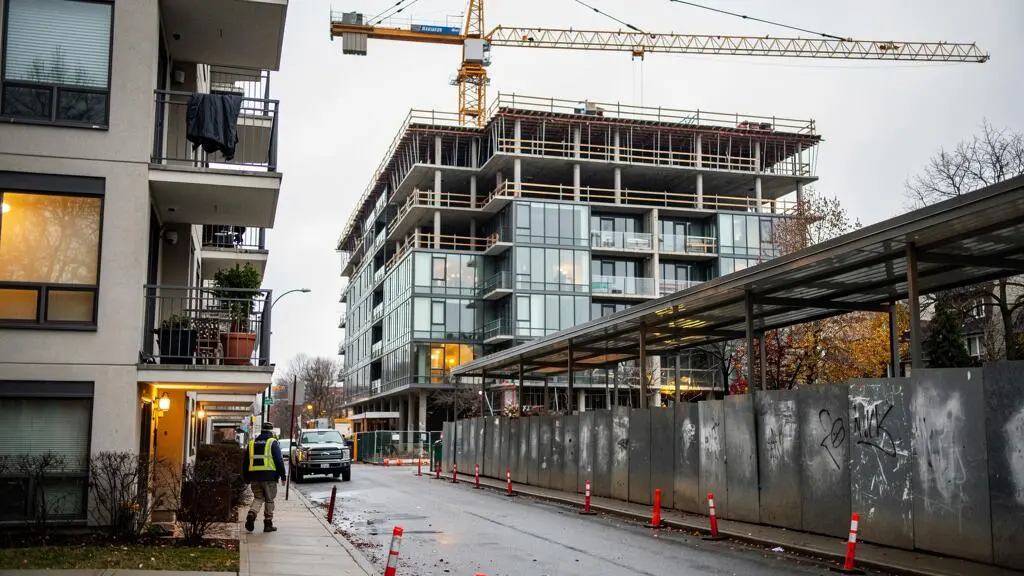
Living beside a high-rise construction project in Canada for 18 months can mean early truck arrivals, intermittent vibration, concrete equipment, dust, blocked sidewalks and changing traffic patterns. The disruption will not remain equally intense throughout that period. Excavation and foundation work often create the most intrusive conditions, while later interior construction can be substantially less noticeable from neighbouring homes.
The challenge is that **18 months of nearby construction does not necessarily mean 18 months until completion**. A neighbouring tower may already be underway when you move in, and its projected finish date may change because of inspections, weather, materials or specialized trades.
For condo owners, renters and nearby homeowners, the practical response is to understand the construction phase, document problems as they happen and make decisions using evidence rather than promises.
Canadian municipalities and provinces regulate different parts of the process. Toronto’s rules offer useful examples, but local requirements must always be checked before making a complaint, asserting a tenancy right or relying on a projected construction schedule.
Living beside construction: the essentials
- Expect changing disruption: excavation, drilling and concrete work generally demand more adjustment than interior finishing.
- Keep evidence from the beginning: dated photographs, noise logs, baseline property conditions and written correspondence help distinguish ordinary inconvenience from potentially actionable problems.
- Plan around the actual phase: temporary relocation, remote-work adjustments and noise mitigation make more sense when matched to scheduled activities rather than an entire advertised construction period.
- Why Do High-Rise Projects in Canada Seem to Take Forever Even With Crews On-Site?
- How to Document Noise and Damage Issues Near a Canadian Construction Site So You’re Taken Seriously?
- Which Is Better During a Canadian High-Rise Build: Staying Put or Moving for 12 Months?
- The Safety Mistake Canadians Make Walking Near High-Rise Construction Zones in Winter
- When Does High-Rise Construction Noise Peak in Canada and How Should You Plan Your Routine?
- Why Are Condos Everywhere in Canadian Cities Even When People Want Houses?
- Why Do Mixed-Use Buildings in Canada Feel Convenient Until Deliveries Start at 6 a.m.?
- Are Mixed-Use Buildings in Canada Worth It if You Hate Noise but Want Walkability?
Why Do High-Rise Projects in Canada Seem to Take Forever Even With Crews On-Site?
High-rise projects appear to take forever because much of the work does not produce visible building height. Excavation, underground parking, inspections, concrete curing and mechanical installation can occupy crews for extended periods. Canadian weather, specialized labour schedules and material deliveries add uncertainty, so a busy construction site can look unchanged from a neighbouring apartment.
The first source of confusion is the difference between physical activity and visible progress. Crews may be installing shoring to stabilize an excavation, waterproofing underground walls, testing systems or correcting deficiencies without adding another floor.
Concrete also needs sufficient strength before loads can be transferred or formwork advanced. Cold weather may require heating, protection and modified construction methods. Winter does not automatically shut down every Canadian high-rise project, but it can change productivity and sequencing.
Specialized trades introduce another layer of dependency. Elevator installation cannot simply be substituted with additional general labour. Glazing depends on manufacturing and deliveries, while certain inspections must occur before work can be concealed or advanced.
### How to identify the construction phase from the street
| What you observe | Likely activity | What it means for neighbours |
|---|---|---|
| Deep excavation, anchors and exposed soil | Shoring, earthworks and underground foundations | Potentially substantial truck traffic, vibration and dust |
| Concrete walls and slabs below street level | Parking structure and foundation construction | Progress may be hard to see from street level |
| Repeated floor formwork and concrete pours | Above-ground structural construction | Regular equipment activity and delivery cycles |
| Glass installation across exterior floors | Building enclosure | Some exterior work continues while interior trades advance |
| Crane dismantling and facade completion | Later construction stages | Major lifting operations may be ending, but occupancy is not assured |
These milestones help identify the phase but cannot establish a reliable number of weeks remaining. A tower with completed glazing may still require extensive mechanical commissioning, fire-safety testing and deficiency correction.
In Toronto, building permits remain open until required inspections are completed and the municipality closes them. The City of Toronto’s building permit closure guidance also describes the municipal permit-status system.
Importantly, Toronto’s administrative definition of a dormant permit concerns inspection inactivity. It is not a measure of how long a high-rise should take to build.
For a practical status check, compare the site notice board, municipal permit records, developer updates and any information available through your condo board or property manager. A sales-launch completion estimate is less useful than recent, verifiable milestones.
A project schedule remains a forecast. Understanding the phase is also the first step toward deciding whether today’s noise and vibration warrant formal documentation.
How to Document Noise and Damage Issues Near a Canadian Construction Site So You’re Taken Seriously?
To document construction problems effectively, record when an incident occurred, what happened, where it was experienced and what evidence supports it. Use dated photographs, written logs and consistent measurements, then compare incidents with the municipality’s permitted working hours. For suspected physical damage, establish the property’s condition before major vibration-producing work whenever possible.
A general statement that construction is unbearable communicates frustration but gives an investigator little to verify.
A useful entry identifies the date, start and end times, type of activity, affected room, observable consequences and any witness. Record whether windows were open or closed and whether the sound was continuous, intermittent or accompanied by noticeable vibration.
Smartphone sound-meter apps can help track patterns, but their readings are not necessarily accurate enough for formal acoustic assessment. Microphone calibration, measurement position and background noise matter. A properly calibrated sound level meter or professional acoustic assessment offers stronger measurement evidence when needed.
### Documenting possible structural damage
Cracks, shifted doors and damaged finishes require a different approach from noise complaints.
A pre-construction condition survey records the existing state of walls, ceilings, foundations and finishes. Where significant excavation, pile driving or blasting is expected, ask whether the project offers neighbouring-property condition surveys. If not, consider commissioning an independent professional assessment where the exposure justifies it.
Photograph existing cracks with a consistent scale reference and record their locations. If damage develops, preserve earlier images and avoid claiming that construction caused it without technical assessment.
Toronto’s large-building permit application requirements include vibration control documentation for applicable projects. However, this does not guarantee that every neighbour can obtain monitoring records or that vibration automatically establishes responsibility for damage.
Where monitoring exists, request relevant information from the developer or appropriate municipal authority. Whether the records are available depends on the project and applicable disclosure rules.
### Who should receive your complaint?
Start by identifying the problem. A site superintendent may address operational concerns. Municipal bylaw enforcement can investigate work-hour or noise-rule issues. A building department may handle certain site-safety matters.
A suspected private-property damage claim may instead require your insurer, an engineer or legal advice. Municipal noise enforcement does not determine private civil liability.
Build a five-part construction evidence file
- Create a dated baseline: photograph vulnerable rooms, walls and existing cracks; save the images in an organized condition folder.
- Maintain an incident log: record times, observed activities and impacts in a continuously updated spreadsheet or notebook.
- Capture supporting evidence: retain original photographs, short recordings and measurement notes with their dates and locations.
- Verify local requirements: save the applicable bylaw provisions, work-hour information and any relevant posted exemption notice.
- Submit a traceable complaint: send a concise description with supporting evidence to the appropriate contact and retain its reference number or written acknowledgement.
Documentation cannot guarantee compensation or enforcement, but it helps establish a timeline and separates observable facts from assumptions about causation. That same record can inform a decision to remain at home or relocate temporarily.
Which Is Better During a Canadian High-Rise Build: Staying Put or Moving for 12 Months?
Staying put is generally more practical when the most disruptive construction stages are short, predictable and manageable inside your home. Temporary relocation becomes more attractive when heavy construction overlaps with essential sleep, remote work or health-related needs. Moving for an entire year is not automatically worthwhile: compare the actual phases, costs and available alternatives first.
A common mistake is treating every month of high-rise construction as equally disruptive.
Excavation, demolition and deep foundation activities can involve vibration, diesel equipment and repeated heavy-truck movements. Above-ground concrete work may produce distinct peaks on pour days. Later interior finishing can remain noisy but may create less direct disturbance outside the building.
If the site is already approaching enclosure, a 12-month move may solve a problem that would have become manageable much sooner.
### Compare the real costs
| Decision factor | Stay in your home | Move temporarily |
|---|---|---|
| Housing expenses | Existing payments continue; mitigation may cost extra | Temporary rent, moving, storage and possible overlapping payments |
| Daily disruption | Noise and access changes remain part of your routine | Exposure may decrease if the replacement home is suitably located |
| Remote work | May require alternate workspace or adjusted calls | Could provide a quieter work environment |
| Control over timing | Can adapt as construction phases change | Must coordinate lease terms, availability and return arrangements |
| Family continuity | School, childcare and neighbourhood routines remain stable | Travel and family logistics may become more complicated |
Before moving, consider measures proportional to the disruption: improving window sealing, using suitable removable window inserts, relocating a desk to a quieter room, or arranging occasional alternative workspace.
Portable cooling may help when windows need to remain closed, but equipment selection, installation safety and ventilation must be considered.
A shorter relocation focused on particularly disruptive activities can be another option. However, an anticipated three- or four-month disturbance window is only a planning scenario, not a guaranteed construction timetable.
### What about renters’ rights?
Canadian residential tenancy rules vary by province. In Ontario, the Landlord and Tenant Board’s tenant-rights interpretation guideline explains how substantial interference with reasonable enjoyment may engage tenant protections.
That does not mean noise from unrelated construction next door automatically entitles a renter to terminate a lease or obtain a rent reduction. The landlord’s responsibilities, source of the interference and circumstances of the case matter.
Renters should check their province’s tenancy legislation before withholding rent or attempting to end a fixed-term agreement.
For owners, investigate whether a temporary rental arrangement is permitted by condominium rules, mortgage conditions, insurance and municipal requirements.
Ask yourself whether the disruption regularly prevents necessary sleep, whether an essential workspace can be relocated, whether dust or vibration creates an unresolved safety concern, and whether moving expenses are sustainable.
If several of these problems are severe and cannot be mitigated, temporary relocation deserves serious consideration.
The strongest decision combines a realistic construction schedule with your household’s specific tolerances. Even if you remain, winter pedestrian safety needs its own plan.
The Safety Mistake Canadians Make Walking Near High-Rise Construction Zones in Winter
The biggest winter pedestrian mistake near a Canadian high-rise site is following the same route used in summer without checking whether it remains safe. Snow can conceal barriers, ice can form around protective structures, and plowed walkways may bring pedestrians closer to truck entrances. A familiar sidewalk is not necessarily a safe or authorized route after a storm.
Construction hoarding and overhead sidewalk protection are intended to separate pedestrians from certain site hazards. They do not eliminate every risk associated with snow, ice, moving vehicles or restricted visibility.
Winter adds several interacting hazards. Water dripping from temporary structures can freeze on pavement. Snowbanks can reduce sightlines near intersections and site gates. Short daylight hours can make uneven ground, temporary ramps and poorly marked detours harder to identify.
Wind can also accelerate between tall buildings and construction barriers, changing how pedestrians experience exposed sidewalk sections.
### Watch construction entrances, not just the sidewalk surface
Pedestrians sometimes choose a freshly cleared path because it appears safer than a snow-covered detour. Unfortunately, that path may lead directly past an active construction entrance.
Heavy trucks require more turning space than passenger vehicles. Drivers may have limited visibility immediately beside the cab or behind the vehicle. Snowbanks and parked equipment can further obstruct views.
Before passing a site entrance, locate the designated pedestrian crossing and observe whether a flagger or traffic-control worker is directing movement.
Never assume that a truck has seen you simply because it is stopped. Avoid crossing behind a reversing vehicle, and do not enter a controlled zone until the authorized traffic controller indicates that the route is safe.
### Recognize hazards that warrant reporting
Visible damage to hoarding, loose overhead protection, displaced barriers, accumulating ice and blocked accessible routes deserve prompt attention.
Do not walk underneath a visibly damaged sidewalk protection structure. Move to a safe location and report the concern to the site contact or appropriate municipal service. If there is an immediate threat to life or public safety, contact emergency services.
Responsibility for pedestrian routes and snow clearing depends on local bylaws, permits and site arrangements. A constructor may have obligations associated with an approved sidewalk occupation, while the municipality retains relevant public-right-of-way responsibilities.
Residents should identify the local department responsible for construction-site public safety and sidewalk obstructions before a problem occurs.
Practical precautions include wearing footwear suitable for icy conditions, avoiding headphones that mask traffic signals and allowing extra time for detours. These measures complement, rather than replace, properly maintained site controls.
A safe route should remain safe even when weather and site activity change. Indoors, managing construction noise requires an equally adaptable approach.
When Does High-Rise Construction Noise Peak in Canada and How Should You Plan Your Routine?
Construction noise commonly peaks during demolition, excavation, foundation installation and other heavy structural operations. Pile driving, drilling and concrete equipment can produce disruptive sound or vibration, while interior finishing is often less noticeable outside the site. The most effective routine follows the current construction phase, daily work schedules and applicable municipal noise restrictions.
Noise is not a single problem. Its impact changes according to the activity, your building’s construction and the room where you spend time.
Deep excavation equipment and pile-driving operations can generate low-frequency sound and vibration that travel through soil and building structures. Formwork, concrete placement and material handling create different patterns, including repetitive impacts or concentrated periods of equipment use.
Later activities such as interior partition installation and mechanical work may still be audible, particularly when windows are open or work occurs close to the neighbouring property.
| Construction phase | Likely disturbance | Useful adjustment |
|---|---|---|
| Demolition and excavation | Impulsive noise, heavy equipment and possible vibration | Identify quieter rooms or alternative daytime work locations |
| Foundation installation | Drilling, equipment cycles and potentially structural vibration | Ask about scheduled operations and document significant events |
| Concrete structure | Pumps, deliveries, forming and occasional concentrated work periods | Plan calls around known delivery or pour schedules where possible |
| Facade and glazing | Exterior equipment, lifting and installation noise | Monitor short-term notices and changing site access |
| Interior finishing | Variable trade activity and mechanical equipment | Reassess whether earlier mitigation is still necessary |
### Understand permitted hours before filing a complaint
Municipal noise restrictions are not identical across Canada.
In Toronto, clearly audible construction noise is generally prohibited between 7 p.m. and 7 a.m. on weekdays, before 9 a.m. and after 7 p.m. on Saturdays, and throughout Sundays and statutory holidays. Approved exemptions can authorize work outside those ordinary periods.
The City of Toronto’s noise regulations and enforcement information describes construction restrictions, noise exemption permits and the city’s 311 complaint process.
These are Toronto-specific provisions, not a nationwide construction timetable. Other Canadian cities may regulate activities and exceptions differently.
Even during permitted hours, residents can ask the site superintendent or property manager whether particularly disruptive activities are scheduled. Concrete deliveries, major lifts and certain equipment operations may be easier to plan around when advance notice is available.
### Address the type of sound, not just its volume
Closing windows and improving seals may reduce some airborne noise. Heavy curtains can affect room acoustics but should not be treated as a substitute for effective sound isolation.
Low-frequency vibration transmitted through a building’s structure is more difficult to address through simple window treatments.
Moving your workstation to a room farther from the construction-facing facade may help. For particularly disruptive activities, an alternate location for meetings or focused work may be more effective than increasing background masking sound.
Avoid using headphones at unsafe listening volumes to overcome construction noise. For sleep, consider the value of a quieter bedroom, consistent ventilation and a predictable routine.
If the source is a persistent generator or mechanical installation, check whether your municipality applies separate rules to stationary equipment rather than ordinary construction activity.
No mitigation eliminates all disturbance. However, the type of project and the surrounding urban environment help explain why such construction is becoming a familiar part of Canadian city living.
Why Are Condos Everywhere in Canadian Cities Even When People Want Houses?
Condos remain prominent in Canadian urban development because land costs, available building sites, infrastructure capacity and housing affordability favour higher-density construction in many locations. People may prefer detached houses while choosing condos to access employment, transit and neighbourhood services. Development economics and planning rules shape what gets built, even when household preferences are more varied.
In established downtown areas, the amount of land available for new detached housing is limited. Acquiring and assembling sites can be expensive, while infrastructure and planning constraints determine which forms of development are practical.
A multi-storey residential project can distribute land costs across more units than a small ground-oriented development. However, building taller also brings substantial costs for structural systems, elevators, fire safety and construction logistics.
Density does not make every high-rise financially viable. Construction costs, financing conditions, municipal charges, achievable selling prices and project approval requirements all influence whether a development proceeds.
### Planning policies influence the type of housing supplied
Many Canadian municipalities and provincial governments support higher-density development near transit and existing urban infrastructure.
The objective can include accommodating population growth while making greater use of established transportation networks and municipal services.
Nevertheless, local zoning, approval processes and infrastructure capacity differ considerably. It would be misleading to suggest that every Canadian city automatically favours towers or that development charges always make taller buildings cheaper.
The housing market also includes townhouses, low-rise apartments, rental buildings and other forms of density. High-rise condominiums are particularly visible because of their scale, lengthy construction periods and concentration in high-demand neighbourhoods.
### Why buyers still choose condos
Housing preferences are constrained by budgets and location.
A household might prefer a detached home with a private yard but choose a condominium to reduce commuting demands, remain near family or purchase in a neighbourhood where houses are financially inaccessible.
Others actively prefer lower-maintenance living, shared amenities and access to services.
Developers respond to the demand they expect to secure at prices sufficient to support construction. What consumers say they would ideally prefer and what they can realistically purchase are not necessarily the same.
### Pre-sales and construction timing
Many Canadian condominium developments use pre-construction sales as part of their financing strategy.
Buyers may commit well before excavation begins. The project must still navigate financing requirements, approvals, procurement and construction planning.
Consequently, a completion date communicated during a sales campaign should not be interpreted as an unconditional delivery guarantee.
Project financing can also become more difficult if market conditions or costs change. This may delay the start of construction, although it does not establish that any particular active site is financially troubled.
For neighbouring residents, the broader lesson is that successive construction projects may occur as an area redevelops. A nearby tower finishing does not guarantee that another site will remain undeveloped.
Before purchasing a home for its current outlook or quiet surroundings, examine permitted land uses, proposed developments and available planning information around the property.
Higher-density development also frequently combines residential units with commercial space. That arrangement introduces a different kind of noise exposure, one that does not necessarily end when construction finishes.
Why Do Mixed-Use Buildings in Canada Feel Convenient Until Deliveries Start at 6 a.m.?
Mixed-use buildings can become noisy because the businesses that make them convenient also need deliveries, waste collection, ventilation and service access. Ground-floor groceries, cafés and restaurants may operate on schedules that begin before residents wake up. Unlike construction disturbance, these operational activities can continue for the entire time you live in the building.
Mixed-use development combines residential accommodation with commercial or other functions within the same building or site.
It can make daily life easier. Residents may reach groceries, cafés, pharmacies and other services without driving. The same convenience attracts customers, suppliers and service vehicles.
The difficulty is that commercial operations need infrastructure residents may barely notice during a daytime viewing.
A loading dock beneath bedrooms can transmit vehicle and equipment noise. Garbage rooms can require frequent collection and handling. Restaurant kitchen exhaust and commercial heating, ventilation and air-conditioning equipment may run beyond ordinary retail opening hours.
These are fundamentally different from the temporary activities associated with a tower under construction.
### Why early deliveries may be permitted
Commercial delivery rules depend on the municipality, type of business, zoning and applicable exemptions.
Toronto provides an instructive example. Its noise regulations distinguish loading and unloading from construction work, with separate restrictions and exceptions for certain commercial activities, including retail businesses and restaurants.
A delivery occurring at 6 a.m. is therefore not automatically a violation simply because a resident finds it disruptive.
Nor does a business’s advertised opening time establish when its suppliers may arrive.
The correct question is whether the specific activity, source and location comply with applicable municipal provisions and building operating requirements.
### Examine the service side of the building before buying
Marketing materials often emphasize the retail frontage, walkable streets and attractive entrances. Service corridors and mechanical equipment deserve just as much attention.
Look for the loading dock entrance, garbage collection areas, service elevators and ventilation outlets. Determine whether any of these are directly below or beside the unit.
Ask where kitchen exhaust is discharged and whether rooftop mechanical equipment is near bedroom windows or outdoor living spaces.
Unit orientation matters. A home on the opposite side of the building may experience a substantially different acoustic environment from one beside a commercial loading bay.
Also examine whether the businesses are already operating. An empty retail unit leaves uncertainty about its future use, and a new tenant may introduce a different schedule or equipment.
A café, restaurant, grocery store and professional office do not necessarily create the same operational conditions.
Before committing, visit during early deliveries, daytime trade and evening closing activity where possible. Conversations with existing residents may reveal recurring concerns that are not apparent during a short viewing.
Construction disruption may eventually disappear, but operational noise depends on the building’s long-term design and tenants. This makes unit selection especially important for noise-sensitive buyers and renters.
Key takeaways before choosing a mixed-use home
- Separate temporary from ongoing disturbance: construction phases end, while commercial deliveries and mechanical equipment can remain part of normal operation.
- Evaluate the individual unit: distance from loading bays, orientation, glazing and nearby ventilation equipment can matter more than the building’s overall marketing description.
- Investigate future changes: commercial tenant turnover and permitted land uses can alter a building’s acoustic environment after you move in.
Are Mixed-Use Buildings in Canada Worth It if You Hate Noise but Want Walkability?
Mixed-use buildings can be worthwhile for noise-sensitive residents when the specific unit is acoustically separated from commercial activity and the walkability benefits meaningfully improve daily life. But convenience alone does not guarantee comfort. The decision depends on which noises you find most disruptive, where the unit is located and what commercial uses may operate nearby.
Walkability offers tangible lifestyle advantages. Being able to reach groceries, public transit and services on foot can reduce reliance on driving and simplify everyday routines.
For some households, those benefits justify occasional street noise or deliveries. For others, sleep disruption and persistent mechanical sound may outweigh the convenience.
The key is to assess the property rather than assuming all mixed-use developments provide the same experience.
### Compare convenience with your noise sensitivity
Consider two forms of disturbance.
**Intermittent noise** includes deliveries, garbage handling, customer activity and periodic loading operations. These events may be predictable but particularly disruptive when they coincide with sleep or focused work.
**Continuous or recurring mechanical noise** can come from ventilation fans, pumps, compressors and other building systems. Some residents find a steady background sound easier to tolerate than sudden impacts; others are more sensitive to low-frequency humming.
A useful decision framework is to score both your expected benefits and likely disruptions using the same personal scale.
| Factor | What to evaluate | Evidence to collect |
|---|---|---|
| Walkability | How often nearby services replace longer trips | Actual walking routes to essential destinations |
| Transit access | Value of convenient commuting | Distance, accessibility and service availability |
| Sleep environment | Exposure to early or late activities | Visits during relevant operating hours |
| Mechanical equipment | Audible or vibrating systems near the unit | Equipment location and available acoustic information |
| Future uncertainty | Potential changes in commercial occupancy | Zoning, permitted uses and condominium records |
This is a personal decision aid, not a scientifically validated rating system. Giving sleep greater weight than convenience may be appropriate for shift workers, families with young children or people who are particularly sensitive to noise.
### Choose the unit, not just the building
Higher floors may reduce direct exposure to street-level loading activities, but height alone is not a guarantee of quiet.
A unit above the commercial floors might still be affected by mechanical equipment mounted on a roof or transmitted through structural elements.
Similarly, a courtyard-facing apartment may avoid street traffic while remaining exposed to loading bays or ventilation outlets located within the courtyard.
Check the building’s design and available acoustic specifications, including window performance and separation between commercial and residential areas.
Acoustic ratings, where documented, must be interpreted in context. Laboratory-tested assemblies do not automatically describe every sound transmission path in an occupied building.
Ask the property manager or condominium corporation whether recurring noise complaints have been reported. Depending on provincial law and your status as a buyer or renter, some records may be available through formal disclosure or document-review processes.
A building with no recorded complaint is not necessarily silent, and complaints alone do not prove a regulatory breach.
### Consider resale and future commercial tenants
Convenient access to amenities can make a property attractive, but resale value is affected by many factors beyond walkability, including market conditions, building quality and operating costs.
Persistent noise may discourage certain prospective occupants, while others may value the location enough to accept it. There is no universal premium or discount applicable to every mixed-use condominium.
Commercial tenant turnover adds another consideration.
A quiet retail space could later accommodate a different permitted business with additional deliveries, ventilation demands or customer activity. Municipal zoning can indicate possible uses, but it does not predict which tenant will occupy a specific space.
Mixed-use ownership structures can also involve shared expenses and decision-making between residential and commercial components. Review the condominium declaration, relevant agreements and available governance records to understand how these arrangements work.
Before committing, visit the unit in the early morning, during the busiest commercial period and in the evening. Speak with current occupants where possible. Identify nearby services, loading routes, waste facilities and mechanical installations.
If the unit is still under construction, rely on plans and technical documents where available, while recognizing that they cannot fully reproduce the experience of an occupied building.
Make the final decision using observations gathered at different times, available building documents and your household’s actual noise tolerance. Walkability is valuable when it improves daily life without creating disturbances you cannot reasonably manage.
Can a Canadian high-rise construction project continue beyond its advertised completion date?
Yes. Construction schedules can change because of weather, inspections, specialized trades, material procurement, financing or unexpected site conditions. An advertised date is not necessarily a contractual guarantee. Check the project’s actual milestones, applicable permits and any formal notices rather than relying solely on promotional material. A building may also require additional testing and approvals after major exterior work appears complete.
Can I complain about construction noise even if work happens during permitted hours?
You can report concerns or ask your municipality for clarification, but a complaint does not automatically establish an offence. Enforcement depends on the local bylaw, noise category, applicable exemptions and evidence. Contacting the site operator may also help with preventable disturbance or advance notice. If you believe there is a safety hazard rather than merely excessive noise, report it through the appropriate safety channel.
Will my condo windows protect me from pile-driving vibration?
Not necessarily. Window performance primarily affects airborne sound transmission, while some construction vibration can travel through the ground and building structure. Better glazing or sealing may reduce certain noises without eliminating vibration. Where significant vibration or property damage is suspected, appropriately documented measurements and professional assessment are more reliable than subjective impressions alone.
Should I buy a condo with an empty lot next door?
Investigate the vacant property’s zoning, available development applications, existing permits and surrounding planning context. An empty lot may eventually be developed, but its future use and timing should not be assumed. Consider how a possible building could affect daylight, views, privacy, traffic and construction exposure. When the information is important to the purchase decision, seek appropriate real estate and legal advice.
Is a higher-floor condo always quieter than a lower-floor unit in a mixed-use building?
No. Higher floors may be farther from street-level deliveries, but they can be closer to rooftop mechanical equipment or other sound sources. Orientation, structural transmission, ventilation design and window performance also matter. Compare individual units and inspect available acoustic information rather than using floor level as the only indicator of quietness.