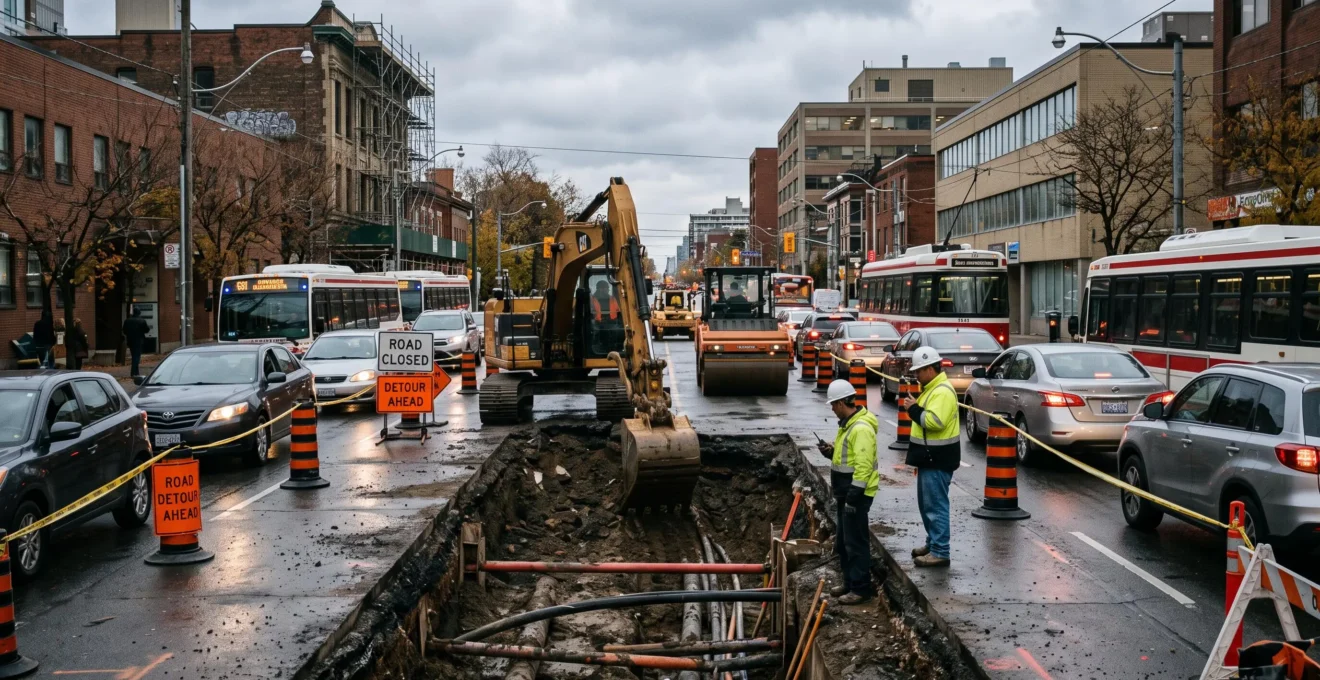
Your city announces millions in infrastructure spending. A few months later, your commute takes longer, buses run behind schedule, and another major road is reduced to one lane. If you live in a growing Canadian suburb, that contradiction can be frustrating.
The explanation starts with a distinction that rarely makes the headlines: money committed to infrastructure is not the same as infrastructure delivered. Roads, transit networks, drainage systems, and public facilities take time to plan, finance, construct, and operate. During that process, existing services may become less convenient before improvements arrive.
Not every project ultimately improves commuting, either. Some protect aging underground utilities, reduce flood exposure, or accommodate future development rather than shorten today’s drive. Others face funding gaps, changing priorities, or delivery delays.
Understanding these differences helps you make practical decisions: whether to change your commuting route, investigate a property before buying, question a budget announcement, or participate in a municipal decision while changes are still possible.
What Canadian residents should know about infrastructure spending
- Construction can reduce road capacity for months or longer, while the eventual benefits depend on what the project actually delivers.
- Approved capital budgets, actual spending, construction milestones, and operating commitments tell different stories about project progress.
- Transit access, stormwater drainage, population growth, and consultation timing can matter as much as additional road capacity.
- Why Do Canadian Infrastructure Projects Make Traffic Worse Before They Get Better?
- How to Read a Canadian City Budget to See Which Infrastructure Projects Are Real
- Which Helps Your Daily Life More in Canada: Better Transit or Wider Roads Near You?
- The Infrastructure Detail Canadians Miss That Turns Basements Into Flood Risks
- When Should You Show Up to a Canadian Infrastructure Consultation to Still Influence It?
- Why Does Population Growth in Canada Strain Healthcare and Transit Before You See Benefits?
- Why Can a ‘Free’ Healthcare System Still Make You Wait Months for a Specialist in Canada?
- How Do You Get Faster Care in Canada’s Public System Without Paying Out of Pocket?
Why Do Canadian Infrastructure Projects Make Traffic Worse Before They Get Better?
Canadian infrastructure projects can make traffic worse because construction temporarily removes road capacity before the new infrastructure becomes usable. Lane closures, detours, utility relocations, and altered intersections push vehicles onto fewer available routes. These disruptions can be a normal part of construction, but they do not guarantee that the completed project will reduce congestion.
Consider a suburban arterial road undergoing reconstruction. Even if the final design provides safer intersections, improved drainage, and better bus access, the construction crew must first work around traffic while excavating pavement and relocating underground services.
That creates a period of construction-induced disruption: fewer usable lanes, lower effective intersection capacity, changed turning movements, and unfamiliar routes. Work performed overnight may also require temporary closures or traffic changes outside regular commuting hours.
The sequence matters. Major reconstruction can involve three overlapping phases:
- Underground preparation: locating utilities, excavating trenches, and relocating pipes or cables.
- Infrastructure installation: rebuilding underground systems, drainage connections, road foundations, and related structures.
- Surface reconstruction: paving, rebuilding sidewalks, installing signals, and restoring access.
The most disruptive period is not necessarily the beginning. Several work zones may operate simultaneously, and traffic arrangements can change repeatedly. The often-mentioned 12–24-month disruption period is not a reliable national rule; the actual duration depends on project scope, staging, contracts, and unforeseen conditions.
To understand your own exposure, record a typical commute time before major restrictions begin, identify the intersections affected, and compare your travel times on equivalent weekdays.
The City of Toronto’s road restrictions and closures information provides a practical example. Its municipal reporting system tracks planned and unplanned road restrictions, closures, and construction activities.
Check your own municipality for comparable roadwork notices and construction maps. A traffic application can help identify congestion, but the municipal project notice is better suited to explaining why a particular road is restricted.
If work appears suspended, check the latest project status, council decisions, tender updates, and approved funding. A quiet construction site does not, by itself, establish that the project has been cancelled.
The important distinction is between temporary inconvenience and lasting performance. To assess whether the inconvenience is likely to produce the promised result, the next step is to examine the money and commitments behind the project.
How to Read a Canadian City Budget to See Which Infrastructure Projects Are Real
To determine whether a Canadian infrastructure announcement represents a funded project, examine the municipality’s approved capital budget, multi-year capital plan, and actual expenditure reports. A press release may describe proposed spending or funding commitments, while financial records reveal the approved allocations, spending timetable, and progress. Even an approved allocation does not guarantee timely construction.
Municipal budgets distinguish money allocated to long-lived assets from money needed for everyday services. Road reconstruction, sewer upgrades, and major transit facilities generally appear in capital planning, while regular maintenance and service operations may be funded through operating budgets.
That distinction matters because an approved infrastructure project can be financially real without being ready for construction.
Start with three questions:
- Is the project identifiable? Find its name, description, project number, or geographic corridor in the city’s capital budget.
- When is funding scheduled? Examine the current year’s allocation and any projected spending in future years.
- What has actually happened? Compare approved amounts with expenditure reports, procurement notices, and construction updates.
Toronto provides a useful example of why approved budgets and spending should not be confused.
83.7%
Toronto’s reported capital spending rate for 2025. Actual capital expenditures were $5.6035 billion against an adjusted capital budget of $6.696 billion, including carry-forward funding from previous years. This is a city-wide measure, not the completion rate of an individual project.
Toronto City Council’s 2025 capital variance report decision, adopted July 29–30, 2026.
The difference between budgeted and actual spending is worth investigating. It does not automatically mean that projects were abandoned or that money was wasted. Capital expenditure timing can change because of procurement, construction schedules, project adjustments, or other delivery circumstances.
Funding arrangements deserve similar scrutiny. Some projects rely on municipal contributions alongside provincial or federal infrastructure funding. A public funding announcement may precede completed agreements, detailed design, or procurement.
Look for the funding status of each partner and whether the reported amounts are committed, approved, conditional, or merely anticipated.
Vague project descriptions, repeatedly deferred spending, and missing construction milestones are reasons to request more information, not proof of political misconduct.
A credible project should become easier to trace as it advances from planning to approval, procurement, construction, and completion. Once you know what is funded, the more personal question is whether that investment will improve the trips you actually make.
Which Helps Your Daily Life More in Canada: Better Transit or Wider Roads Near You?
Better transit can provide greater everyday benefits where residents can reach useful destinations through frequent, reliable service. Wider roads may be more valuable where car travel remains essential and specific intersections lack capacity. Neither option automatically solves congestion: the practical result depends on neighbourhood density, trip patterns, service quality, road design, and long-term travel demand.
In a growing suburb, transportation decisions should start with actual travel needs rather than the number of lanes or kilometres of transit infrastructure announced.
A new bus stop is not especially useful if service is infrequent or ends before your evening shift. Similarly, an extra road lane may not meaningfully shorten your commute if the principal delay occurs at an unchanged intersection farther along the route.
Use the following comparison to evaluate what a proposal could change for your household.
| Decision factor | Better transit | Wider roads |
|---|---|---|
| Best potential fit | Corridors with concentrated travel demand and accessible destinations | Locations with demonstrated vehicle-capacity constraints |
| Daily convenience | Depends on frequency, transfers, travel time, and operating hours | Depends on bottlenecks, intersections, and traffic patterns |
| Household costs | Fares and access to stops or stations | Fuel, vehicle costs, and parking |
| Long-term limitation | Low frequency or poor connections can undermine benefits | Additional vehicle demand may absorb some added capacity |
| Useful alternatives | Bus priority and improved service on existing routes | Intersection changes and maintenance of existing roads |
Added road capacity can encourage additional driving over time, particularly where congestion previously discouraged trips or influenced route choices. The size of that response varies by location and cannot be established from a generic widening announcement.
Canadian geography also makes a major difference. Statistics Canada‘s public transit accessibility indicator reports that, in 2025, 82.3% of urban residents lived within 500 metres of a transit stop, compared with 11.3% of rural residents.
Those figures measure proximity, not whether a bus arrives frequently, operates on weekends, or reaches a workplace without lengthy transfers.
For a low-density community, repairing existing roads or improving selected intersections may offer more immediate benefits than constructing an expensive transit corridor with limited potential ridership. In a busier suburb, improving bus frequency and reserving road space for buses may move more people through a constrained corridor without relying entirely on additional general-purpose lanes.
Hybrid projects deserve attention. Bus-priority lanes, bus rapid transit, and complete-street designs can address several transportation problems together. Their relative costs and benefits must still be assessed locally rather than assumed to be lower or higher.
Mobility is only one outcome of infrastructure spending. Underground systems can have an equally direct effect on household finances, particularly when drainage deficiencies place basements at risk.
The Infrastructure Detail Canadians Miss That Turns Basements Into Flood Risks
Stormwater drainage is an easily overlooked infrastructure factor that can affect basement flood risk. When rainwater exceeds the capacity of drains, sewers, or local drainage routes, water can accumulate near foundations or enter buildings through vulnerable openings. Sewer backups create another possible pathway. The risk depends on local systems, building characteristics, rainfall, and protective measures.
Roadwork near your property may therefore deserve attention for reasons unrelated to traffic.
A municipal reconstruction project can involve underground storm sewers, catch basins, road grading, and temporary drainage arrangements. The finished road may look nearly identical, even though the underlying work changes how rainfall is collected and conveyed.
Canadian municipalities can operate different sewer configurations. A combined sewer carries sanitary sewage and stormwater in the same system. A separated system uses distinct networks for sanitary wastewater and stormwater.
During heavy rainfall, combined systems may face capacity pressures that contribute to sewer backups. Separate systems are not automatically flood-proof: stormwater pipes, sanitary connections, foundation drains, and surface drainage can still present problems.
For homeowners, the practical issue is identifying which drainage systems serve their property and which protection measures are appropriate. Municipal flood-risk maps, stormwater management reports, sewer information, and local basement flooding programs can help inform that assessment.
Toronto, for example, expanded its municipal basement flooding protection subsidies beginning May 1, 2026. Its program offers qualifying homeowners up to 6,650
The City of Toronto’s Basement Flooding Protection Subsidy Program covers eligible protective measures including plumbing assessments, backwater valves, sump pumps, and battery backup systems.
That assistance is specific to eligible Toronto properties. It should not be interpreted as a nationwide subsidy or a guarantee that any particular property will qualify.
During nearby construction, ask the municipality how temporary drainage will be managed, where runoff is expected to flow, and whom residents should contact if water begins accumulating unexpectedly. An engineer or qualified plumbing professional can assess building-specific risks.
Five checks to document your home’s drainage exposure
- Find your municipality’s available flood-risk information and save the relevant map or an email confirming that no applicable map is available.
- Ask which sewer system serves your street and retain the municipality’s written response.
- Review the local stormwater management or roadwork plan and record any drainage changes affecting your block.
- Request an assessment of relevant protective measures, keeping the professional’s findings and recommendations.
- Check municipal subsidies, permit requirements, and insurance conditions; save a summary of what applies to your property.
Property risk is often shaped by decisions made long before construction crews arrive. That makes early participation in infrastructure planning particularly important.
When Should You Show Up to a Canadian Infrastructure Consultation to Still Influence It?
The most useful time to participate in a Canadian infrastructure consultation is before the major budget and design choices are finalized. Early planning discussions may influence project priorities and alternatives, while later consultations often focus on narrower details such as access, crossings, landscaping, and construction arrangements. The precise decision stages and participation rights vary by municipality.
Infrastructure proposals commonly move through planning, technical studies, budget approval, design development, procurement, and construction. However, these stages can overlap, and public engagement may occur at different points depending on the project.
By the time a detailed construction notice reaches nearby households, changing the project’s overall purpose may be difficult. Altering construction access arrangements or raising a specific safety concern may still be feasible.
That is why the right question is not simply, “When is the public meeting?” It is, “Which decisions are still open?”
Before attending, obtain the project presentation, available design drawings, technical studies, and proposed timeline. Identify who is responsible for approving the next stage.
Then frame your comments around concrete outcomes. For example:
- Will pedestrians have an accessible crossing throughout construction?
- Can bus-stop access be maintained for residents without cars?
- Does the proposed design account for school arrival and dismissal periods?
- How will drainage and driveway access be managed during excavation?
- Which design elements are still open to modification?
These questions are more actionable than a general objection that construction will be inconvenient.
If the formal consultation has already closed, examine the municipality’s procedures for addressing council or committees, submitting written comments, or contacting the relevant ward councillor. Deadlines, speaking arrangements, and petition requirements are not uniform across Canada.
Residents may also benefit from coordinating submissions through a neighbourhood association or a group of affected households. Shared evidence about a specific accessibility or safety issue can make the concern easier for municipal staff to evaluate.
Participation should not be confused with a veto. A consultation does not necessarily mean that every major design alternative remains available, and public comments do not guarantee a project change.
Early engagement matters even more in fast-growing communities, where pressure on transportation and public services can build faster than planned infrastructure becomes available.
Why Does Population Growth in Canada Strain Healthcare and Transit Before You See Benefits?
Population growth can strain Canadian healthcare and transit services because demand increases as residents arrive, while additional infrastructure and staffing require planning, funding, construction, recruitment, and operating arrangements. A growing community may therefore experience fuller buses and greater pressure on medical appointments before new capacity opens. The severity of the gap depends on local conditions and planning.
Think of a hypothetical suburb where several residential developments are occupied while a new transit corridor remains in design and a planned community facility has not yet been built.
The new households begin using existing roads, buses, clinics, and public facilities immediately. The proposed additions may still need construction contracts, operating budgets, qualified staff, and connections to existing networks.
This is a capacity-timing problem, not necessarily evidence that all growth is harmful or that every infrastructure project has failed.
Healthcare and transit also have different delivery responsibilities. Municipalities generally manage many local roads and transportation services, while healthcare planning and delivery depend substantially on provincial or territorial systems and healthcare organizations.
A city can approve nearby residential development without directly controlling specialist availability or the staffing of a hospital.
To assess your community, compare three types of information:
- Demand: population growth and development forecasts from Statistics Canada, municipal planning material, and regional documents.
- Capacity: existing transit service, public facility availability, and relevant healthcare service information.
- Delivery: approved capital projects, expected completion milestones, and plans for operating or staffing new facilities.
Consider transit access carefully. Statistics Canada’s 2025 indicator showed a substantial difference between urban and rural proximity to stops, but physical proximity alone does not indicate available bus capacity or reliable service.
A municipality may serve more residents without adequately increasing service frequency, vehicle availability, or route coverage. Conversely, improvements to scheduling or existing operations may provide benefits before a major construction project is completed.
Watch for a recurring mismatch: approved housing growth accompanied by infrastructure plans that have no comparable delivery timetable or clear operating commitments.
Some consequences of that mismatch are visible every morning on crowded roads. Others appear when residents try to access healthcare, where physical infrastructure is only one part of the capacity problem.
Why Can a ‘Free’ Healthcare System Still Make You Wait Months for a Specialist in Canada?
Canada’s publicly funded healthcare system generally covers medically necessary physician and hospital services for eligible residents, but coverage does not guarantee immediate specialist appointments. Patients are usually referred through a clinician, and waiting times depend on medical urgency, specialist availability, regional resources, and clinical capacity. A wait lasting several months is possible, but there is no single national waiting period.
The term “free healthcare” can obscure how the system operates. Eligible medically necessary services are generally funded through provincial or territorial insurance rather than billed directly to patients at the point of care.
That financing arrangement does not eliminate the practical limits created by the available workforce, equipment, facilities, and appointment slots.
Specialist access commonly begins with a referral from a family physician or another authorized healthcare professional. Referral rules and access pathways vary by jurisdiction and specialty.
The receiving service assesses the clinical information and may prioritize patients according to urgency and available capacity. Consequently, two people seeking the same type of specialist can experience different waits.
An urgent referral may be scheduled ahead of a routine one. However, urgency is determined through clinical assessment, not simply by how long someone has already waited.
Patients should therefore avoid treating another person’s waiting time as a prediction of their own.
To understand a pending referral, ask the referring clinician whether it was sent, whether it was accepted, and whether further tests or information are needed.
Where appropriate, ask whether alternative referral destinations, specialized assessment clinics, or regional wait-list arrangements are available. Such pathways are not identical across provinces and specialties.
Follow-up care from a nurse practitioner, primary care professional, or another qualified provider may also be appropriate while waiting, depending on the medical situation.
Provincial insurance coverage has boundaries. Outpatient prescription drugs, dental care, physiotherapy, and certain mental health services may have different funding arrangements, eligibility criteria, or out-of-pocket costs.
Check the rules of your own provincial or territorial health plan rather than assuming that every healthcare-related service is insured.
If symptoms worsen while waiting, seek medical reassessment. A change in clinical condition may require a different level of care rather than simply an earlier appointment within the existing referral queue.
While a resident cannot personally expand hospital capacity, there are practical ways to reduce avoidable administrative delays and identify appropriate publicly funded care options.
Key takeaways before seeking care
- Confirm that a referral has actually reached the receiving service before assuming you are on a waiting list.
- Ask about medically appropriate alternatives within your provincial or territorial system, without assuming that every region offers the same programs.
- Use urgency-based services for genuine medical needs, not merely as a workaround for routine appointment delays.
How Do You Get Faster Care in Canada’s Public System Without Paying Out of Pocket?
You may be able to access appropriate publicly funded care sooner by confirming referrals, exploring available providers, requesting cancellation-list opportunities, and using suitable primary care or urgent-care services. These measures can reduce avoidable delays, but they cannot guarantee a faster specialist appointment. Eligibility and available pathways depend on your province or territory, medical needs, and local capacity.
The first step is to establish where your request stands.
If you are waiting for a specialist, contact the referring clinic and ask whether the referral was sent successfully. Ask whether the receiving service has acknowledged it and whether any further documentation is required.
Where contact information is available and the service permits patient inquiries, ask about cancellation appointments and whether your schedule could accommodate short-notice availability. Not all offices maintain cancellation lists.
Confirm that the clinic has your current telephone number and other contact information so that appointment offers are not missed.
Next, discuss clinical alternatives with an appropriate healthcare professional. Depending on the problem and local availability, these could include a nurse practitioner, another primary care provider, a specialized assessment pathway, or a publicly funded virtual care service.
If you do not have a regular primary care clinician, investigate the patient attachment or registration process offered in your jurisdiction. Being on a registry does not guarantee immediate placement, but it can establish a formal request for ongoing primary care.
Telephone health advice services, including 811 in many Canadian jurisdictions, may help residents identify appropriate services and the urgency of their symptoms. Availability and the services provided vary geographically.
Walk-in clinics and urgent-care centres can be appropriate for certain non-life-threatening concerns. They are not substitutes for emergency treatment when symptoms are severe or potentially dangerous.
For an emergency, call 911 or seek emergency care as appropriate.
Finally, verify what is publicly insured. Some assessments, prescriptions, therapies, and other services may fall outside standard provincial or territorial coverage or qualify only for particular groups.
Financial assistance programs may exist for certain medications, dental services, travel related to medical treatment, or other needs. Their eligibility conditions cannot be assumed across Canada.
Keeping a simple record of referral dates, clinic responses, appointments, and medical instructions can make follow-up more efficient and reduce uncertainty about the next step.
For your next step, confirm the status of any pending referral and identify the appropriate publicly funded service available in your province or territory. For infrastructure concerns affecting your commute or property, apply the same principle: consult the responsible authority, establish what has actually been approved, and act on the details you can verify.
Does an infrastructure spending announcement mean construction is about to start?
No. Announcements may concern proposed budgets, funding commitments, planning work, or projects already under construction. Check the approved capital budget, procurement status, project updates, and expected start date to determine which stage applies.
Can nearby construction affect my property’s drainage even if my street does not flood regularly?
Construction may involve temporary drainage arrangements or permanent changes to grading and underground systems. Whether these affect a particular property requires a site-specific assessment. Ask the municipality about drainage controls, review available project plans, and seek qualified professional advice if you identify a concern.
Where can I check whether a road project near my home has been delayed?
Start with your municipality’s construction notices and project pages. Compare the latest schedule with previous updates, and look for changes in budget reports, council records, or procurement notices. For a specific explanation, contact the responsible municipal project office.
Will a new residential development automatically lead to better transit service?
No. Additional residents can increase the demand for transit, but service improvements depend on planning decisions, available funding, vehicles, staffing, and operating arrangements. Look for approved frequency increases or route changes rather than relying solely on a development announcement.
Can residents request changes after an infrastructure project has already been approved?
Sometimes. Major funding or design choices may already be settled, but residents may still be able to raise concerns about construction access, pedestrian safety, drainage, or other implementation details. Check municipal council and committee procedures and ask project staff which decisions remain open.