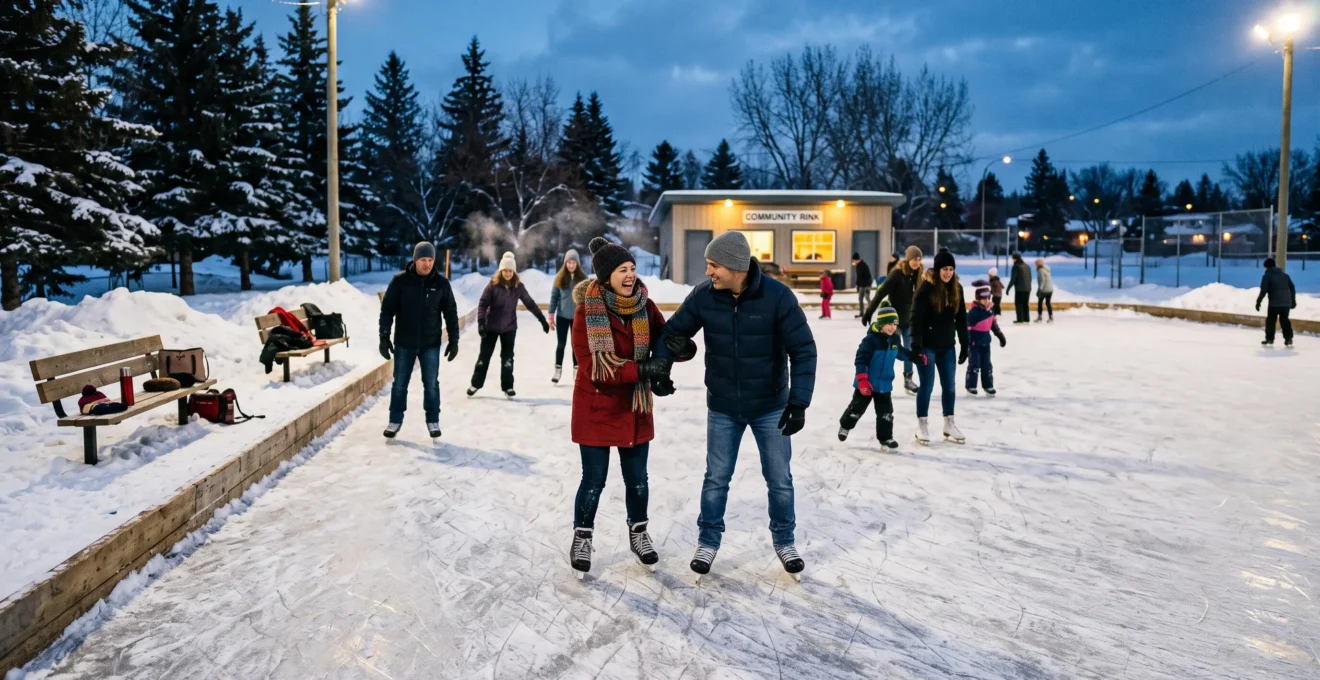
Your first Canadian winter can feel like more than a change in weather. Shorter days, unfamiliar routines and fewer spontaneous outdoor encounters can make even a welcoming neighbourhood seem difficult to enter. Yet winter also brings opportunities to meet people through shared activities, from public skating and community suppers to local festivals and volunteer projects.
The most useful Canadian traditions for building a sense of home are not necessarily the most famous. A recurring activity where neighbours recognize one another may help you establish relationships more readily than attending a major celebration once. What matters is finding something that fits your interests, schedule and community.
Traditions also differ considerably across Canada. An Atlantic Canadian kitchen party, a Prairie community supper and a neighbourhood gathering in Montréal may look different while offering similar opportunities for conversation and participation. Understanding these differences helps newcomers and interprovincial movers engage without assuming that every Canadian shares the same customs.
There is no need to become a hockey fan, learn to skate or adopt someone else’s cultural identity. Building connections begins with curiosity, respectful participation and the willingness to return.
Canadian winter traditions: What matters most
- Start locally: Community centres, libraries, skating activities and neighbourhood gatherings offer practical opportunities to meet people.
- Participate authentically: Ask questions, contribute when appropriate and share your own traditions without feeling obliged to imitate others.
- Look for regular contact: Festivals introduce you to local culture, while recurring activities provide more opportunities to develop relationships.
- Why Do Canadian Traditions Look Different in the Prairies vs Atlantic Canada but Still Feel Familiar?
- How to Join Canadian Traditions as a Newcomer Without Feeling Like You’re “Pretending”?
- Which Helps You Connect Faster in Canada: Big Festivals or Small Neighbourhood Rituals?
- The Tradition Mistake That Makes Canadians Think You’re Stereotyping Them
- When Are Canadian Traditions Most Accessible for Newcomers if You Work Weekdays?
- Why Does Cultural Preservation Matter in Canada When We’re Already Multicultural?
- Why Do Canadians Feel More “Connected” During Playoffs Even if They Don’t Know the Players?
- Why Do Professional Sports Matter So Much to Canadian Cities Even if You Never Watch?
Why Do Canadian Traditions Look Different in the Prairies vs Atlantic Canada but Still Feel Familiar?
Canadian traditions differ because geography, livelihoods, settlement histories and local cultures shape how communities gather. Prairie community suppers and Atlantic Canadian kitchen parties may involve different activities, but both can create opportunities to share food, exchange stories and spend time together. Recognizing the social purpose behind a tradition makes unfamiliar regional customs easier to approach.
In parts of the Prairies, agricultural histories and rural community life have influenced gatherings such as community suppers, agricultural fairs and rodeos. These activities can bring neighbours together around shared interests, local organizations and community events. Their significance extends beyond the meal or entertainment: people have opportunities to recognize familiar faces and participate in community life.
Atlantic Canadian traditions reflect different historical and geographical influences, including fishing communities, maritime life and regional musical cultures. One recognizable example is the kitchen party, where gathering around food, music and storytelling becomes an occasion for social connection.
Destination Canada‘s description of Atlantic Canadian kitchen parties traces the tradition to neighbours gathering in homes to share meals, conversation and music. Contemporary interpretations may also take place in public or organized settings.
Consider two hypothetical experiences: someone moving to Saskatchewan attends a community supper and helps clear the tables, while another newcomer in Newfoundland joins a gathering where guests exchange stories and sing. Neither person needs to understand every local reference to participate meaningfully.
The activities differ, but their shared purpose is recognizable: creating space for people to spend time together.
Other regions add important variations. Québec has its own French-language cultural traditions, winter celebrations and community gatherings, while Ontario combines many local, regional and cultural influences. Northern communities, Indigenous nations and urban immigrant communities contribute further traditions that cannot be reduced to a Prairie–Atlantic comparison.
A useful way to understand an unfamiliar tradition is to distinguish its visible activity from its underlying purpose:
- The activity: Sharing a meal, attending a festival, skating or listening to music.
- The social purpose: Meeting neighbours, maintaining relationships, celebrating heritage or supporting community life.
- Your possible role: Attending respectfully, asking questions, helping with an event or becoming a regular participant.
Regional differences are an invitation to learn about the specific place where you live, rather than a test of how much Canadian culture you already know.
How to Join Canadian Traditions as a Newcomer Without Feeling Like You’re “Pretending”?
You can participate in Canadian traditions authentically by showing genuine interest rather than trying to perform a particular version of Canadian identity. Attend activities that appeal to you, ask about unfamiliar customs and contribute in ways that feel comfortable. Participation does not require abandoning your own background or pretending that a local tradition has always been yours.
Imagine being invited to a community potluck during your first winter. You might wonder whether you should prepare a supposedly traditional Canadian dish. In most cases, that is unnecessary unless the organizers have specified a theme. Bringing something familiar from your own cooking can provide an equally natural starting point for conversation.
The distinction is between contribution and imitation. Contribution means taking part in the shared activity. Imitation means adopting gestures or customs primarily to appear as though you belong.
For example, helping to arrange chairs before a community meal gives you a useful role. Pretending to understand every cultural reference in a conversation does not.
A practical approach is to build involvement gradually:
- Observe the first time. Attend an event, understand its atmosphere and learn whether newcomers are expected to participate in specific ways.
- Take on a small role next time. Bring an appropriate contribution, help with setup or join an activity after checking with the organizers.
- Extend an invitation. Once a connection develops, suggest coffee, another community activity or a cultural exchange of your own.
This is a suggested method, not a universal Canadian social rule. Some people are comfortable participating immediately; others prefer a slower introduction.
It is also worth distinguishing a genuine invitation from casual courtesy. An event advertised as open to the public generally welcomes visitors, subject to any stated conditions. A private gathering requires an actual invitation. When uncertain, asking whether guests or volunteers are welcome is more reliable than interpreting someone’s friendliness as permission.
Remaining an observer is not inherently disrespectful. However, if you want to develop relationships, eventually introducing yourself or taking part may create more opportunities for interaction.
Sharing your own cultural practices can enrich these encounters. Present them as something you would enjoy exchanging with others, without suggesting that local traditions need to be replaced.
Belonging does not require a convincing performance. It becomes possible when people have repeated opportunities to get to know one another as they are.
Which Helps You Connect Faster in Canada: Big Festivals or Small Neighbourhood Rituals?
Big festivals can introduce newcomers to Canadian culture quickly, while smaller recurring neighbourhood activities often provide better conditions for developing lasting relationships. Festivals offer shared experiences without requiring ongoing involvement. Community rituals create opportunities to encounter the same people repeatedly. Combining the two can help you explore a new city and gradually develop a familiar social circle.
A winter festival provides an easy starting point if you are unsure where to go or how to participate. You can enjoy the atmosphere, observe local customs and find conversation topics without immediately committing to an organization.
Winterlude in Ottawa–Gatineau illustrates this approach. Its 2026 edition ran from January 30 to February 16 and included ice carving, outdoor entertainment, cultural activities and scheduled free events. The program also provided transportation between official festival sites on selected days.
Canadian Heritage‘s Winterlude 2026 program announcement documents those activities. That schedule concerns the completed 2026 edition, not the upcoming 2026–2027 winter.
Such festivals can offer memorable introductions, but attending once does not guarantee a continuing relationship. A neighbourhood activity offers a different possibility: seeing familiar people again.
Imagine attending a free public skating session at the same community rink every Saturday. Initially, you might recognize only the staff. Over several visits, you may begin greeting other regulars, discussing the weather or arranging to meet again. Shared routines give conversations a natural reason to continue.
The practical differences between the two formats become clearer when compared directly.
| Criterion | Big festivals | Neighbourhood rituals |
|---|---|---|
| Typical commitment | One event or visit | Repeated participation |
| Social entry point | Shared entertainment and activities | Familiar people and routines |
| Relationship opportunities | Often brief or spontaneous | More opportunities for follow-up |
| Preparation | Check dates, access and costs | Check recurring schedules and participation rules |
| Potential limitation | Contacts may remain temporary | Relationships may develop gradually |
Neither format guarantees friendship. Personality, accessibility, language, local circumstances and the welcoming practices of organizers all influence the experience.
Winter also makes indoor gathering places particularly useful. Libraries, recreation centres, neighbourhood halls, cultural associations and places of worship may provide recurring programs when outdoor activities are less appealing.
For a newcomer, one possible strategy is to attend a public festival, identify an activity worth repeating and then make regular participation the priority.
The festival may provide your first shared memory of a place. A familiar weekly gathering may eventually make that place feel like your own neighbourhood.
The Tradition Mistake That Makes Canadians Think You’re Stereotyping Them
The most common cultural mistake is assuming that a familiar Canadian symbol describes every Canadian person’s identity, interests or traditions. Hockey, maple syrup, winter sports and regional expressions can be useful conversation starters, but they are not universal experiences. Asking people about their actual interests and communities shows more respect than telling them what Canadians are supposed to enjoy.
National symbols can help newcomers recognize cultural references. The problem begins when these symbols turn into assumptions about individuals.
For example, telling a colleague that they must love hockey because they grew up in Canada assigns an interest they may not have. Asking whether hockey is popular in their neighbourhood leaves space for a more informative conversation.
Similarly, treating every person from Québec as having identical linguistic or cultural experiences overlooks differences within the province. Referring to Indigenous peoples as though they share a single set of ceremonies or traditions overlooks the distinct identities and cultural authority of individual First Nations, Inuit and Métis communities.
The distinction is between curiosity and cultural assignment.
- Instead of “Every Canadian watches hockey,” ask “Is hockey something people follow around here?”
- Instead of “Everyone in Atlantic Canada has kitchen parties,” ask “Are kitchen parties part of the local traditions in your community?”
- Instead of “Québec has one distinct way of celebrating winter,” ask “Are there winter celebrations that are especially meaningful where you grew up?”
- Instead of assuming an Indigenous cultural activity is open to outsiders, ask the organizers whether public participation is invited and what protocols apply.
There is no need to avoid cultural conversation altogether. In fact, excessive caution can prevent enjoyable exchanges about music, family celebrations, regional food and community life.
The goal is simply to leave room for personal differences. A person might enjoy a national tradition, participate only occasionally or feel no connection to it at all.
Regional stereotypes can also obscure generational change. A custom familiar to older relatives may not be part of a younger person’s daily life, while immigrant and intercultural communities may have introduced additional practices that now shape local celebrations.
Listening carefully allows you to discover which traditions are actually meaningful to the people around you.
Respectful curiosity often creates a more useful connection than arriving with a supposedly complete understanding of Canadian life.
When Are Canadian Traditions Most Accessible for Newcomers if You Work Weekdays?
Newcomers who work weekdays can often explore Canadian traditions through weekend festivals, evening recreation programs, community suppers and occasional volunteer opportunities. Availability depends on the city, season and organization rather than a fixed national schedule. Checking municipal calendars and community-program listings helps identify activities that fit your working hours without requiring an ongoing commitment.
Many community organizations advertise weekend or evening activities, but it would be misleading to assume that most Canadian traditions follow a single timetable. The most suitable option is the one whose actual schedule matches your availability.
For someone working a conventional Monday-to-Friday schedule, possible starting points include public skating sessions, neighbourhood events, recreational leagues and cultural gatherings. Some volunteering opportunities may also accommodate evenings or weekends.
Seasonal changes create additional possibilities:
- Winter: Public skating, indoor cultural programs, winter festivals, neighbourhood meals and recreational sports.
- Spring: Community cleanups, cultural events, markets and locally organized outdoor activities.
- Summer: Street festivals, neighbourhood gatherings, outdoor performances and community sports.
- Autumn: Harvest celebrations where locally relevant, community meals, cultural programs and indoor recreation.
These are examples of activities to look for, not guarantees that they are offered in every municipality.
For newcomers working nights, rotating shifts or weekends, daytime library activities, flexible volunteer opportunities and settlement programs may provide alternatives. Some services require registration or have eligibility conditions, so checking those details before attending is important.
IRCC‘s community connection resources for newcomers identify libraries, recreation centres, sports clubs, neighbourhood activities and volunteering as ways to build local connections. The federal guidance also describes settlement services and the Canada Connects initiative, which helps eligible newcomers meet established community members.
These resources offer practical starting points, although program availability and eligibility can vary.
Your five-step plan for finding a winter community activity
- Identify two local venues. Find a nearby library and recreation centre, and save their names and official program pages.
- Choose three possible activities. Record the activity name, location and published schedule in a short list.
- Check participation requirements. Confirm whether registration, equipment, payment or eligibility conditions apply, and save the relevant details.
- Select one realistic first visit. Add the event to your calendar with its address and any preparation required.
- Plan a possible return. After attending, record whether you enjoyed the experience and identify the next available session if you want to participate again.
Volunteering can be particularly useful when a person prefers having a defined task rather than entering a gathering solely to socialize. Helping prepare an event or welcome participants provides a practical reason to communicate with others.
However, one volunteer shift is not guaranteed to produce closer relationships than attending several community activities. The value depends on the experience, the people involved and whether further contact develops.
A manageable activity that you genuinely enjoy is more likely to become part of your routine than an ambitious social plan that conflicts with your everyday responsibilities.
Why Does Cultural Preservation Matter in Canada When We’re Already Multicultural?
Cultural preservation matters in multicultural Canada because diversity does not automatically ensure that individual traditions, languages and community knowledge survive. Multiculturalism recognizes the value of different cultural identities while supporting participation in shared public life. Preserving local heritage and welcoming newcomers are therefore complementary goals, not competing expectations.
Canada’s federal multiculturalism policy dates to 1971. Multiculturalism was subsequently recognized in section 27 of the Canadian Charter of Rights and Freedoms in 1982, and Parliament enacted the Canadian Multiculturalism Act in 1988.
The Act recognizes cultural heritage, participation and equality as important public objectives. It supports opportunities for people from different backgrounds to preserve and share their traditions while participating in Canadian society.
Canadian Heritage’s official explanation of the legislation describes cultural preservation and equitable participation as compatible objectives.
This helps explain the idea often called Canada’s cultural mosaic: different cultural traditions can remain recognizable while contributing to a broader society. The mosaic metaphor is useful, although Canadian communities are more complex and interconnected than any simple comparison with a melting pot suggests.
Consider a regional language, a community craft tradition or a locally significant celebration. Its continued practice may depend on people teaching it, organizing gatherings and passing on knowledge. A diverse population alone cannot guarantee that these activities will continue.
Preservation requires active transmission, and the appropriate form of participation depends on who holds the tradition and how it is shared.
For example, a newcomer attending a publicly organized Acadian cultural celebration can learn about local heritage and contribute to the event’s community presence. If the organizers welcome volunteers, helping with an event may provide another meaningful way to support it.
Attending performances, purchasing work directly from cultural practitioners and supporting community organizations can also contribute. It would be inaccurate to suggest that only hands-on participation has cultural value.
Indigenous traditions require particular care. First Nations, Inuit and Métis peoples have distinct histories, cultural practices and authorities over their own knowledge and ceremonies. Cultural revitalization is not simply another form of public entertainment.
Some Indigenous cultural events explicitly welcome members of the wider public. Other activities have restrictions or protocols determined by the relevant community. An invitation to attend a public event should never be interpreted as permission to participate in every ceremony, record cultural practices or reproduce them elsewhere.
Respectful participation means following the specific community’s guidance rather than relying on general assumptions about Canadian multiculturalism.
A multicultural community becomes richer when cultural exchange is accompanied by attention to the people, histories and responsibilities behind each tradition.
Why Do Canadians Feel More “Connected” During Playoffs Even if They Don’t Know the Players?
Sports playoffs can create a sense of connection because people follow the same unfolding event and gain a shared topic of conversation. Knowing the players is not always necessary. In communities where a team attracts attention, the atmosphere surrounding an important game can provide an accessible way to participate in local excitement without becoming a dedicated sports fan.
Playoffs have a distinctive social rhythm. Games occur within a defined competition, results influence what happens next and supporters experience moments of anticipation together.
This creates opportunities for conversation outside the sports venue. Colleagues might discuss the previous night’s result, neighbours may notice team colours and friends may arrange to watch a game together.
For someone unfamiliar with the sport, a simple question can provide an opening: “Is this an important game for the team?”
No detailed knowledge of the rules is needed to ask why people are excited. In many settings, someone who enjoys the sport may be happy to explain, although individual reactions naturally vary.
There are several ways to participate, depending on your interest and comfort:
- Watch casually at home. Learn the basic context and recognize references that may come up in conversation.
- Join a public viewing. Where available, a neighbourhood venue or organized gathering provides an opportunity to experience the atmosphere with others.
- Attend a local game. Junior, amateur or community-level sports may offer opportunities to encounter people who regularly participate in the local sporting scene.
These options serve different purposes. A major televised playoff game may create a memorable shared occasion, whereas regularly attending local sports can provide repeated opportunities for conversation.
Not every city or community experiences playoffs with the same intensity. Enthusiasm depends on the teams involved, local sporting culture and individual interests. Professional hockey may dominate attention in some settings, while basketball, soccer or other sports may matter more elsewhere.
It is also entirely possible to feel connected through community activities that have nothing to do with sports.
For newcomers, the practical value of a playoff season is its shared conversational context, rather than any obligation to follow scores or become a supporter.
When the excitement ends, a local recreation group, amateur team or recurring community gathering may offer a way to maintain some of the connections that began during the event.
Key takeaways before exploring city sports culture
- Knowing a city’s popular teams can help explain local conversations and public celebrations, even if watching sports is not your interest.
- Professional sports and neighbourhood recreation are connected in some communities, but access to local programs should always be checked separately.
- The most useful cultural references are those that help you understand your city without pressuring you to adopt someone else’s interests.
Why Do Professional Sports Matter So Much to Canadian Cities Even if You Never Watch?
Professional sports matter to many Canadian cities because teams can become recognizable symbols of local identity, shared history and civic pride. Their influence reaches beyond dedicated fans through public conversations, celebrations and community activities. Understanding a city’s sporting culture can therefore help newcomers interpret everyday references even when they have little interest in watching games.
A professional team often represents more than its athletes. Its name, colours, rivalries and memorable seasons can become part of a city’s public identity.
For someone moving to Toronto, understanding why residents discuss the Maple Leafs or Raptors may help make local conversations more understandable. In Montréal, the Canadiens occupy a recognizable place in the city’s sporting culture. Other Canadian cities have their own professional teams and sporting histories.
These examples do not mean that everyone in those cities supports the same team, or that sports are equally important to all residents.
Professional sports also interact with the wider community through activities such as youth programs, charitable initiatives and recreation partnerships. Some sports organizations support local participation opportunities, although the types of programs and their accessibility depend on the organization and location.
It is important not to confuse a professional team’s presence with a guarantee of accessible public recreation. Municipal facilities, school programs, independent sports associations and community volunteers have their own roles in providing local activities.
For a newcomer, basic sports awareness can be useful without requiring personal involvement.
You might learn which teams represent your city, recognize when an important competition is taking place and understand why a particular result matters to people around you. That is enough to follow the social context of many conversations.
However, local identity extends far beyond professional sports. Food traditions, cultural festivals, neighbourhood organizations, artistic communities and public spaces also shape how residents understand their city.
If sports do not interest you, there is no need to force a connection. A regular library program, community meal, recreational class or cultural association may provide a more meaningful route into local life.
What connects these different experiences is the opportunity to develop shared references with other residents. A city begins to feel familiar when its events, places and routines become part of your own experience.
For your next step, choose one community activity that genuinely interests you, check when it meets and make a first visit. If you enjoy it, return and get to know the people involved. A sense of home can begin with something as simple as recognizing a familiar face during your next Canadian winter outing.
Do you need to know how to skate to participate in Canadian winter traditions?
No. Skating is only one of many winter activities available in Canadian communities. Libraries, community centres, cultural organizations and neighbourhood groups may offer indoor programs, shared meals, volunteering and other opportunities that require no skating experience. Choose activities based on your interests, accessibility needs and local availability.
Can newcomers attend community events if they do not know anyone?
Yes, when an event is advertised as open to the public and any registration or eligibility requirements are satisfied. Public festivals, community-centre programs and newcomer activities can provide starting points. For private gatherings or events with unclear participation rules, contact the organizer before attending.
What if you feel uncomfortable speaking English or French at a community gathering?
Start with an activity that allows you to participate without prolonged conversation, such as volunteering on a practical task, taking a recreation class or attending a public cultural event. Language conversation circles and newcomer programs may also be useful. Ask organizers about available language support rather than assuming it is provided.
Are Canadian winter traditions always free to join?
No. Some community activities and public festival programs are free, while others require admission, registration fees, equipment or personal contributions. Review the organizer’s published information before attending. Municipal libraries, recreation centres and newcomer-serving organizations are useful places to investigate accessible local options.
How can you find Canadian traditions that reflect your own cultural background?
Explore local cultural associations, community centres, public libraries, neighbourhood events and organizations serving newcomers. These groups may offer celebrations, activities or opportunities to share cultural practices. You can also participate in traditions outside your background when they are open to the public and you follow the organizers’ guidance.