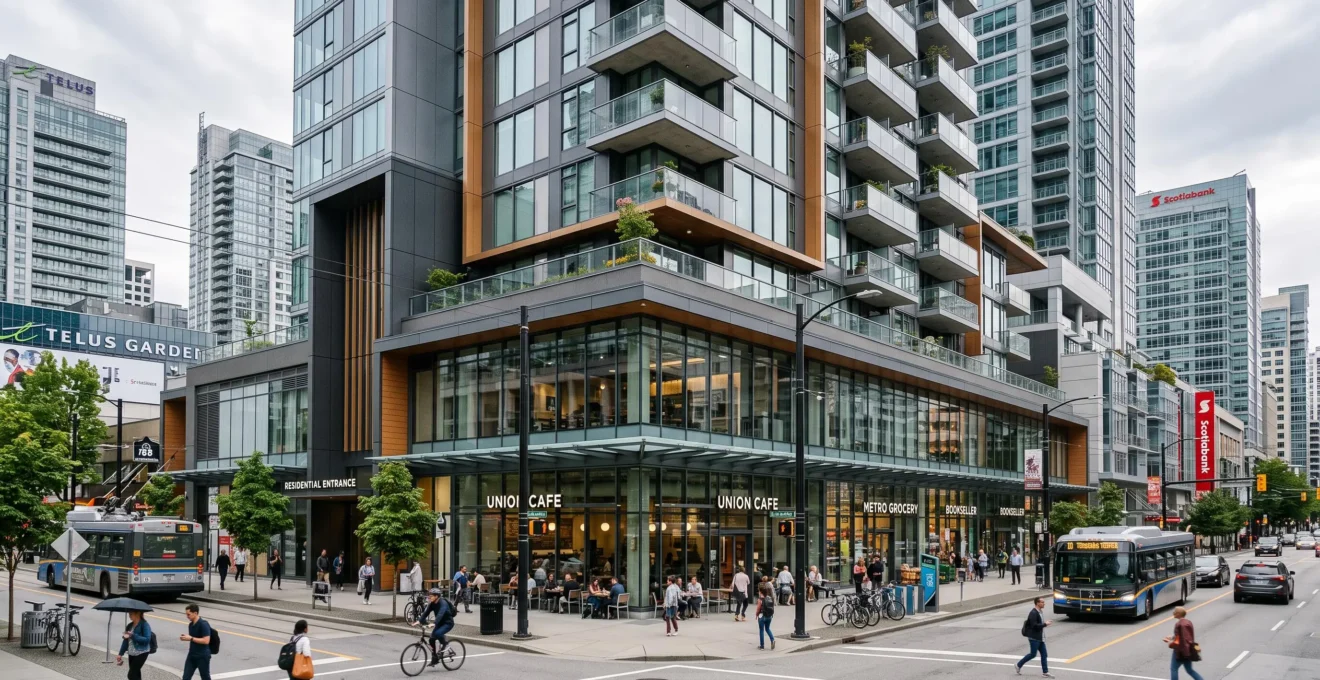
Living above a grocery store sounds ideal until a delivery truck starts unloading beneath your bedroom window. In Toronto, Montréal and Vancouver, mixed-use buildings offer something increasingly valuable: groceries, cafés, transit and daily errands within walking distance. But their commercial spaces also create noise, traffic and operational activity that a conventional residential building may not have.
For someone sensitive to noise, the question is not whether mixed-use housing is inherently good or bad. It is whether a particular unit separates residential life from commercial operations effectively enough to make its convenience worthwhile.
A bedroom above a restaurant’s mechanical equipment can have a very different acoustic environment from an apartment overlooking a small pharmacy across a quiet street. Construction phasing matters too: an apparently completed residential tower may still have unfinished storefronts or another tower scheduled next door.
The most useful approach is to evaluate the actual commercial tenants, loading arrangements, bedroom orientation, building documents and surrounding development plans before committing to a lease or purchase.
Mixed-use living in Canada: the essentials
- Convenience is not the same as quiet: identify delivery areas, mechanical equipment and commercial operating hours before choosing a unit.
- Unit placement matters: retail below, retail across the street and a commercial loading lane create different types of disturbance.
- New buildings require extra investigation: residential occupancy does not guarantee that commercial fit-outs or neighbouring construction are finished.
- Why Do Mixed-Use Buildings in Canada Feel Convenient Until Deliveries Start at 6 a.m.?
- How to Evaluate a Mixed-Use Building in Canada in 30 Minutes During One Visit?
- Which Is Easier to Live With in Canada: Retail Under Your Unit or Retail Across the Street?
- The Mixed-Use Detail Canadians Miss That Can Trigger 12 Months of Construction Noise
- When Should You Move Into a New Mixed-Use Building in Canada to Avoid the Noisiest Phase?
- Why Are Condos Everywhere in Canadian Cities Even When People Want Houses?
- Why Do High-Rise Projects in Canada Seem to Take Forever Even With Crews On-Site?
- What Should You Expect Living Near a High-Rise Build in Canada for 18 Months?
Why Do Mixed-Use Buildings in Canada Feel Convenient Until Deliveries Start at 6 a.m.?
Mixed-use buildings can feel exceptionally convenient because everyday services are immediately accessible. The difficulty is that commercial operations follow different schedules from residential life. Early deliveries, waste collection, ventilation systems and closing-time cleaning may interrupt otherwise quiet periods. A 6 a.m. delivery is a realistic scenario to investigate, not a universal operating schedule for Canadian retail buildings.
The first distinction is between structure-borne noise and airborne noise. Structure-borne noise travels through connected building elements. A compressor mounted against a shared wall, equipment vibrations or impacts at a loading dock can sometimes be noticeable several floors away, depending on the building’s acoustic design.
Airborne noise travels through the surrounding environment: street conversations, patio activity, vehicle engines and delivery alarms. Window quality, façade design, floor height and bedroom orientation can change how much reaches the apartment.
Think of commercial noise as a daily schedule rather than a constant background condition. A grocery tenant may receive morning deliveries and operate refrigeration equipment continuously. A restaurant can add kitchen extraction, evening customers and late cleaning. An office-oriented commercial unit may have a narrower activity window, although its equipment still deserves inspection.
Personal sensitivity makes these differences important. Some residents tolerate one short, predictable delivery but struggle with an intermittent compressor or repeated reversing alarms. Neither reaction should be assumed universal. Consider which sounds interrupt your own sleep, concentration or ability to relax.
Municipal rules also matter. The City of Toronto noise regulations generally restrict loading and unloading noise overnight, but include exceptions for categories such as retail businesses, restaurants and waste collection. General restricted hours therefore do not guarantee that commercial deliveries cannot occur early.
Vancouver and Montréal operate under their own municipal frameworks. Check the applicable by-law, property location and any authorized exceptions instead of applying Toronto’s rules to another city.
A building that is occasionally busy at a tolerable hour may suit you better than one with quieter streets but unpredictable equipment vibrations throughout the night.
How to Evaluate a Mixed-Use Building in Canada in 30 Minutes During One Visit?
A focused 30-minute inspection can reveal many mixed-use building risks before you make an offer. Start at the commercial loading area, examine the relationship between retail spaces and residential entrances, and assess the apartment’s bedroom exposure. One visit cannot prove that a building is quiet, so combine this initial inspection with a return visit at a contrasting time.
Begin outside rather than in the furnished unit. Locate the loading dock, garbage storage, restaurant exhaust outlets and truck access route. Notice whether commercial vehicles need to reverse beside residential windows or whether they have a separate service lane.
Then inspect the unit’s relationship to those activities. A bedroom facing a loading bay may be more exposed than a living room overlooking the same area. Check whether windows open toward mechanical equipment, restaurant terraces or a busy arterial road.
Ask the property manager who manages the commercial component, which business activities currently operate and whether operating or delivery hours are established in the relevant agreements. Request information about past noise complaints, while recognizing that management may not maintain or disclose a complete complaint history.
For an Ontario resale condo, the Condominium Authority of Ontario’s status certificate information explains that buyers can request a status certificate containing the corporation’s declaration, by-laws and rules. This material helps with due diligence, but it does not necessarily contain commercial leases or establish actual acoustic performance. Québec and British Columbia have different disclosure frameworks.
Your five-action mixed-use property inspection
- Identify the service route: walk around the block and mark the loading dock, garbage area and truck entrance on a building photo.
- Check bedroom exposure: record the bedroom’s orientation relative to the street, terrace, service lane and mechanical equipment.
- Ask about operations: obtain written confirmation of known commercial tenants and available information about their operating and delivery arrangements.
- Review the documents: identify the relevant condominium rules, commercial-use provisions and any unresolved building-management questions.
- Schedule a contrasting visit: record a second inspection appointment for early morning or a weekend evening, when commercial activity may differ.
A practical first visit might allocate roughly ten minutes to the exterior, ten to the apartment and ten to questions and document requests. Treat that allocation as a screening method, not an acoustic test.
If a critical concern remains unanswered, return during the relevant operating period or obtain specialist advice before committing to the property.
Which Is Easier to Live With in Canada: Retail Under Your Unit or Retail Across the Street?
For noise-sensitive residents, retail across the street is often easier to investigate and may be easier to live with because there is no direct structural connection between the commercial premises and the apartment. However, a busy restaurant patio across a narrow street can be more intrusive than a well-isolated shop downstairs. Business type, operating hours and bedroom orientation matter more than distance alone.
Retail directly beneath an apartment creates a shared-building relationship. Vibrations from equipment, impacts from deliveries and potential odour transfer through building defects or poorly separated air systems require particular attention. Effective construction and mechanical isolation can greatly reduce these risks.
Retail across the street removes the direct shared-floor connection but leaves outdoor sound transmission. Vehicle movements, customer conversations, music and patio cleaning can reach exposed bedrooms, especially when windows are open.
The comparison becomes clearer when the main sources of disturbance are separated.
| Consideration | Retail under your unit | Retail across the street |
|---|---|---|
| Structural vibration | Potential transmission through connected building elements | No direct structural connection to your building from that business |
| Street and patio noise | Depends on façade, entrance placement and unit orientation | Depends on street width, exposure, traffic and business hours |
| Mechanical equipment | Check shared walls, floors, shafts and rooftop units | Check exposed equipment and airborne sound paths |
| Odours | Inspect ventilation separation and potential leakage paths | Consider outdoor exhaust locations and prevailing airflow |
| Convenience | Commercial entrance may be within the same building | Usually requires a short street crossing or walk |
Street classification can reverse the apparent advantage. A small neighbourhood business across a local street may create relatively modest activity, while a mixed-use tower on a truck-heavy arterial road may experience substantial traffic noise regardless of the ground-floor tenant.
Compare a hypothetical pharmacy operating largely during daytime hours with a late-opening restaurant that uses outdoor seating. Their potential disturbance profiles differ even when both occupy identical commercial spaces.
Also investigate whether commercial uses might change. A currently quiet tenant does not guarantee identical operations in the future. Ask which uses and operating arrangements are permitted, recognizing that leases, planning rules and condominium restrictions address different issues.
The quieter choice is usually the one with the better combination of use, operating hours, physical separation and bedroom protection—not simply the greater distance from the nearest storefront.
The Mixed-Use Detail Canadians Miss That Can Trigger 12 Months of Construction Noise
The overlooked detail is project phasing. A residential tower may become occupied before its commercial units, neighbouring blocks or later towers are complete. Residents can therefore move into an apparently finished building while retail fit-outs and adjacent construction continue. Twelve months is a possible planning scenario, not an established or standard duration for mixed-use construction noise in Canada.
Developers may deliver different components on different schedules. Residential occupancy can proceed while ground-floor businesses are still securing tenants, designing interiors or arranging equipment installations. A later phase may occupy land that looks like an open courtyard or temporary parking area during an early viewing.
Retail fit-out noise is often underestimated because it follows the main structural construction. Interior drilling, cutting, ductwork and mechanical installation can occur after residents receive their keys. This is particularly frustrating when buyers believe the noisiest stage has already ended.
Before buying pre-construction, request a complete development phasing plan, not just the expected completion date for your unit. Identify the phase number, commercial possession arrangements, remaining building blocks and whether future work will directly face your windows.
Municipal construction-noise rules restrict certain working hours, but do not generally impose a universal maximum duration for an entire development. For example, Vancouver’s Noise Control By-law 6555 distinguishes construction on private property from work on streets and lanes. Its ordinary private-property construction hours differ between weekdays and Saturdays, and exception permits can authorize work outside standard hours.
Those rules are not interchangeable with Montréal or Toronto requirements. Even a project that respects municipal hours can remain disruptive during permitted daytime periods.
Documents should also distinguish shell construction from tenant improvements. A completed concrete structure does not establish that drilling, ventilation installation or service-vehicle activity has ended. Ask whether commercial spaces will be delivered as finished premises or unfinished shells awaiting tenant work.
Understanding the complete sequence is more useful than accepting an unsupported promise about when the building will finally feel settled.
When Should You Move Into a New Mixed-Use Building in Canada to Avoid the Noisiest Phase?
The best move-in window for someone who dislikes noise is generally after the most disruptive nearby construction and major commercial fit-outs have finished. That does not require every shop to be occupied, but it does require checking what work remains. Moving into the first completed residential phase may provide earlier access to the neighbourhood while exposing residents to ongoing development activity.
Think of the project in three broad stages: structural construction, residential finishing and commercial fit-out. Structural construction can involve heavy equipment, concrete work and substantial truck activity. Residential finishing may be less dramatic outdoors but still create intermittent interior noise. Commercial fit-outs can occur after residents have moved in.
Ask the developer for the scheduled residential occupancy date, the commercial handover timeline and the anticipated construction sequence for other phases. Check municipal permit information where publicly accessible, and observe whether storefronts, loading facilities and landscaping appear operational or remain construction zones.
In Ontario, buyers of eligible new condominium units should examine the Statement of Critical Dates in the applicable Tarion Addendum. Tarion’s condominium occupancy and delay protections describe occupancy deadlines, potential extensions and certain purchaser remedies. These protections concern the applicable contractual occupancy framework; they do not guarantee that surrounding construction or retail work will be complete.
There is also a financial and practical trade-off. Early buyers may have access to a wider initial selection or particular launch offers, while later buyers can sometimes inspect more of the completed environment. Neither lower early prices nor higher later prices should be assumed without comparing actual market offerings.
A late-phase unit is not automatically quiet. In a multi-tower development, additional construction may be planned beside or beyond that building. Investigate the entire site rather than equating your tower’s completion with the end of construction.
If timing is flexible, consider renting nearby or revisiting the property after commercial units begin operating. Direct observation helps distinguish temporary construction exposure from the permanent operating conditions of the finished neighbourhood.
The goal is not necessarily to arrive last, but to understand which unfinished activities your household would actually experience after moving in.
Why Are Condos Everywhere in Canadian Cities Even When People Want Houses?
Condos are prominent in Canada’s largest urban markets because multi-unit development can accommodate more households on expensive, limited land. Planning policies, transit investment and development economics can also favour higher densities in specific locations. This does not mean everyone prefers a condo or that every municipality requires retail beneath housing; it means the available housing supply reflects constraints beyond individual preferences.
Land costs are particularly important. Where a desirable location commands a high site price, spreading that cost across many homes may make a denser project more financially feasible than building detached houses. Building costs, financing conditions, zoning permissions and market demand still determine whether a project proceeds.
Municipal plans may also encourage compact development near transit corridors and centres where walking, cycling and public transportation are practical alternatives to driving. Ground-floor shops and services can support active streets, although requirements differ by site and municipality.
For a buyer or renter who dislikes noise, the implication is that mixed-use housing may be a realistic option in the walkable neighbourhoods they prefer. Rejecting every building with retail can exclude otherwise suitable apartments without guaranteeing quieter surroundings.
The more useful comparison may be between a carefully selected urban condo and a quieter location that requires more driving. Both choices impose costs, but those costs are experienced differently: one may involve occasional deliveries, while the other may involve daily travel time and reduced access to nearby services.
Pre-construction development adds another consideration. In growing districts, several projects may progress on neighbouring sites over multiple years. Even a completed residential-only building can face temporary construction exposure when surrounding land is redeveloped.
Choosing a quieter unit within a walkable district may offer a better compromise than treating detached housing and mixed-use towers as the only possible alternatives.
Why Do High-Rise Projects in Canada Seem to Take Forever Even With Crews On-Site?
High-rise projects can appear to make little progress because visible construction is only one part of a long, dependent sequence. Permits, inspections, specialized trades, equipment installation and material deliveries must align before successive tasks can finish. Workers may be present every day while critical activities remain delayed, and the resulting schedule changes affect both occupancy expectations and the duration of nearby noise.
Major construction stages depend on earlier work. Excavation and foundations support the structure; the structure enables enclosure; and the building envelope allows more interior work to proceed under protected conditions. Mechanical, electrical and life-safety systems require installation, coordination and inspection before relevant areas can be completed or occupied.
Specialized labour availability, design revisions and supply-chain problems can interrupt these sequences. A delayed component may affect later tasks even when another crew can keep working elsewhere on the site.
From the street, visible construction milestones provide useful but limited clues:
- Excavation and foundation equipment: substantial ground-level work may still be underway.
- Crane and rising concrete floors: the structural phase is visibly progressing.
- Windows and façade panels: enclosure is advancing, but interior systems may remain incomplete.
- Removed scaffolding and finished landscaping: exterior completion is advancing, although commercial interiors may still be unfinished.
These observations cannot replace the actual construction schedule. Work hidden inside a tower may be complex even when the exterior looks almost complete.
For pre-construction purchasers, an advertised occupancy date should be read alongside contractual extension provisions and relevant purchaser protections. The rights associated with delayed delivery depend on the province, agreement and applicable warranty framework.
Noise also changes with construction stages. Foundation work may generate vibration, structural activity may involve frequent concrete deliveries, and interior finishing may create more localized intermittent sounds. A longer schedule does not necessarily mean the same intensity of noise continues throughout.
Knowing the phase and its remaining dependencies gives residents a more realistic basis for planning than relying on crane activity or an optimistic completion announcement.
Key takeaways before living beside construction
- Evaluate the actual work remaining, not just the developer’s advertised completion month.
- Separate temporary construction noise from permanent traffic, retail and mechanical noise.
- Prioritize bedroom orientation, work-from-home needs and your ability to tolerate weekday disruption.
What Should You Expect Living Near a High-Rise Build in Canada for 18 Months?
Living near a Canadian high-rise construction site for 18 months can mean changing levels of noise, vibration, dust and traffic disruption rather than one continuous period of intense disturbance. Excavation, structural work and finishing create different conditions. Eighteen months should be treated as a hypothetical planning horizon, not a standard project duration or a reliable prediction for any particular development.
During excavation and foundation work, residents may notice drilling, heavy machinery, truck movements and ground vibration. The effects depend on the site, construction methods, soil conditions and distance from the work.
As the structure rises, concrete deliveries, lifting operations and construction equipment can become more prominent. Later, façade installation and interior finishing may produce less street-level activity while continuing to generate intermittent noise.
The final stages can still involve significant disruption. Landscaping, sidewalk restoration, utility connections and commercial tenant improvements may continue after the most visible construction equipment has disappeared.
Location within the neighbourhood changes the experience considerably. An apartment facing an excavation site may receive direct airborne noise and dust. A unit overlooking the truck route can experience repeated vehicle movements even when the main work occurs farther away. An apartment facing a protected courtyard may be less exposed, although this should be assessed on site.
Municipal noise rules are not guarantees of daytime silence. Restrictions, exemptions and complaint procedures depend on the municipality and type of activity. Some operations can be authorized outside ordinary construction hours, while permitted daytime work may still be intrusive.
Before renting or purchasing, inspect the neighbourhood during active construction hours. Ask about the remaining excavation, structural and finishing stages, and identify where trucks enter, queue and exit. For an existing tenancy, review applicable lease provisions and local tenant protections if construction conditions become a serious concern; the existence of nearby construction does not automatically establish a contractual remedy.
For someone who works from home, daytime construction may create more difficulty than evening commercial activity. For someone who sleeps during the day, the same project could be especially disruptive. Compare the expected schedule with the hours when quiet matters most to you.
There is also an important distinction between temporary and lasting impacts. Construction eventually concludes, although the timeline may change. The completed building, its commercial tenants, vehicle access and surrounding street design can create a different, permanent pattern of activity.
A hypothetical comparison illustrates the decision: one apartment faces an active construction site but has no major commercial service area nearby. Another has no adjacent construction but overlooks a restaurant’s loading zone. The first may offer a temporary disturbance followed by quieter conditions; the second may expose the resident to recurring commercial activity. Without project and operating information, neither should automatically be considered preferable.
Before signing a lease or purchase agreement, make one final comparison: how many daily errands could you realistically complete on foot, which noise sources would affect your sleep or work, and which disturbances are temporary rather than permanent? Choose the unit whose documented conditions match your priorities—not simply the one with the most attractive shops downstairs.
Can a mixed-use condo be quiet enough for a light sleeper?
Yes, depending on the building’s acoustic separation, mechanical equipment, commercial tenants and bedroom orientation. A mixed-use designation alone does not establish the noise level inside an apartment. Visit during periods of commercial activity, inspect the bedroom with windows closed and open, and consider professional acoustic assessment if a specific vibration or noise concern remains unresolved.
Can a new restaurant replace a quiet retail tenant beneath my condo?
A change of commercial tenant may be possible, but the permitted use depends on applicable zoning, approvals, building requirements, condominium governing documents and commercial agreements. A currently quiet storefront should not be treated as a permanent guarantee of low-impact occupancy. Ask which commercial uses are permitted and whether relevant restrictions can be documented.
Does a higher floor always mean less noise in a mixed-use tower?
No. Higher floors can have less direct exposure to some street-level activities, but may be closer to rooftop ventilation equipment or have an unobstructed sound path to nearby roads and construction sites. Mechanical vibrations can also travel through connected building elements. Evaluate the exact unit rather than relying on its floor number.
Can renters investigate building noise before signing a lease?
Yes. Renters can inspect exterior service areas, visit at different times, ask the landlord about known disturbances and check applicable municipal noise regulations. They can also ask whether commercial spaces are occupied or awaiting renovation. However, renters may not have access to the same condominium and development documents as purchasers, and information provided verbally should not be treated as a guarantee.
Is a residential-only condo necessarily quieter than a mixed-use building?
No. A residential-only building may still be exposed to major roads, construction, transit infrastructure, neighbouring businesses or noisy building equipment. Conversely, a well-designed mixed-use building with controlled commercial access and effective acoustic separation may offer acceptable conditions for noise-sensitive residents. Compare actual sound sources, not building labels.